- Home
- Puppy Obedience Training
- Train your dog to come to you
How To Train Your Dog To Come Back When Called!
Train Your Dog To Come
You must train your dog to come back to you as early as you can.
Teaching your puppy recall is one of the most important things you will ever teach your Cocker Spaniel, and someday it could even save his life! Read on to learn how to train your puppy to respond to the recall command.
Train Your Dog to Come Back When Called
Train Your Dog to Come Back
Training your dog to come back when you call him will be one of your first priorities and should be started as soon as possible before he has the opportunity to pick up any bad habits.
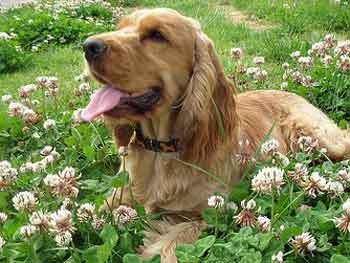 Just chilling, Mum!
Giving your Cocker Spaniel early obedience training guarantees your puppy will grow into a well-behaved, confident adult dog.
Of course, you want to train your dog to come back to you when called but, you will probably find that this obedience training is one of the most difficult to achieve.
However, you mustn't give up because at some point, this training may be used to remove your puppy from potential harm, and it could even help to save his life!
Your objective is to get your puppy to come to you each time you call him, no matter what your pet is doing or where he is, as long as he's able to see or hear you.
Unfortunately, training a puppy to come to you when you call him may not always be as straightforward as it sounds, particularly with Cocker Spaniels or other scent driven dogs.
He's more likely to want to sniff around in the undergrowth, following the scent of rabbits or foxes, but don't let that stop you. Keep at it!
Patience and regular training will help you achieve your goals.
Train Your Dog To Come To You
Begin this exercise indoors, but only when you're confident that you won't be disturbed and that nothing is lurking that could possibly distract your dog.
- Let your puppy see that you have a treat in your hand. Don't give it to him; just let him sniff it.
- Have a friend hold your puppy's collar to stop him from following you.
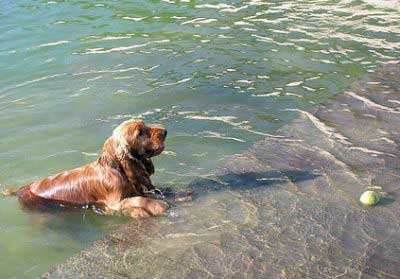 Come on Mum, throw the ball again, please!
- Walk away from your puppy (a few paces should be far enough, to begin with), and then turn around to face him.
- Call him (to get his attention) and then call him using the recall word that you've chosen, for example, 'Max, come' or 'Max, here boy'.
- Try to sound exciting to your puppy: clap your hands; slap your thighs or knees. Be animated, whatever works for you.
(Any of these movements may be used as your visual command, or you could choose another; but whatever you decide, use it consistently.) - If your puppy seems unsure of what you're asking him to do, try taking a few quick steps backwards as you call his name. This should entice him to come bounding towards you.
- When your puppy reaches you, give him the treat immediately and then praise him with the words, 'Come, good boy come', (or whatever recall-word you've chosen) and make a silly fuss of him.
When you're training your puppy, you must reward him the instant he reaches you. Have your puppy's reward treat ready in your hand.
If you have to search for a treat in your pocket or treat bag, it will be too late to reward him because he simply won't associate the reward with his action.
- Ask your friend to call the puppy back. If your pup obeys the command, your friend can reward him with a treat and the relevant praise.
- Repeat calling your puppy back and forth between you and your friend (and each member of your family), and your Cocker will soon respect this command from other people.
Practice these training exercises several times during the day. Make sure to space them out so that your puppy doesn't get overwhelmed!
As your dog begins to master this recall instruction, gradually extend the distance between you and your Cocker before calling him.
Train Your Dog To Come When You're Outside!
Train Your Dog To Come, Outdoors
Once your Cocker Spaniel has mastered the recall indoors, it's time to take him into the garden (so long as it's dog and puppy proof) to train your dog to come to you when outside.
This is especially important as most of your recalls will be outside where there are many distractions such as birds, exciting smells, or next door's cat!
Once you're confident you can train your dog to come back to you in the garden, and he gets it right every time, you can take him to the local park and test his recall there.
One thing to bear in mind is that your dog may begin to associate the recall command with being put back on his lead and taken home.
If this happens, and he links the two in his mind, he may be reluctant to return to you when he sees his lead in your hand.
We need to ensure he doesn't make this connection.
So, the next time you walk your puppy, let him off his lead and call him back after a few minutes, praise him and put him back on his leash.
Walk him for a minute or two and then let him off again.
Practice this (calling him to you, putting him back on his lead and then letting him off again) several times during your walk.
Do this, and you'll find it won't be too long before he is trotting merrily back to you, despite holding his lead in your hand.
Tips To Help You Train Your Dog To Come To You
Tips: Train Your Dog To Come
There are a few tips I can give you to help you train your dog to come back the first time you call him, for example:
- whenever you get the chance, call your puppy to you just to give him a cuddle or to play a while. Reward him with cuddles and praise when he responds.
- gradually increase the distance you move away from your puppy before calling him to you.
- begin replacing the treats with cuddles, praise, play or a chew toy as soon as you can get away with it. You don't want an obese puppy!
- if treats don't float your dog's boat, find out what does and use that as a reward. It may be a favourite toy, a few minutes of playtime, a cuddle or a simple belly rub!
- never repeat the instruction more than once (twice at a push), as this will only teach your dog that he doesn't need to respond to your first request.
- If you find yourself in a situation where you know your dog is not going to come back to you readily, don't call him.
You'll be setting him (and yourself) up to fail, and in time, your puppy may learn that he doesn't need to respond to your command because you allow him not to. - If you feel you're getting nowhere with your dog's training, don't get angry and don't shout when calling him. He's unlikely to respond and will associate your anger with your command.
Keep your voice light and, even though you may not feel like it, try to sound exciting and encouraging to your puppy.
You want your dog to learn that good things happen to him when he comes back to you (like treats and cuddles!). - If you are to train your dog to come back to you every time, vary the training exercises to make them more interesting for him.
You might like to try a version of hide-and-seek with your puppy. Go into another room, out of sight, and then call his name.
Wait until he tracks you down before rewarding him either with a bit of rough and tumble, or his favourite toy and lots of lavish praise.
Puppy obedience training isn't just for puppies; it also works for an adult dog who's never been trained or whose manners have lapsed. However, with adult dog training, it may take you a little longer.
Train Your Dog To Come: Troubleshooting
Train Your Dog To Come
What If My Puppy Won't Come Back?
Puppies are usually happy and excited to come to you when you call them. However, as they get older, they become a little more inquisitive and independent.
Trust me, they will try to test you!
If your puppy fails to return to you when called, give him a minute or two extra. He may eventually come to you in his own time.
When he does, or even if he begins to come back to you and then gets distracted, make a fuss of him.
However, on this occasion, don't reward him with a treat. Only give treats when your puppy responds immediately.
Training your puppy in this way (rewarding good behaviour and ignoring misbehaviour) will be much more effective, and your puppy will learn more quickly.
What If My Puppy Runs Away?
If your Cocker Spaniel won't come to you when called and decides to run off instead, don't be tempted to chase him.
All dogs love chasing games, and if you go running after him, he'll think it's fun and will carry on running away from you.
Instead, make a lot of noise (hopefully to distract him), turn around and begin to run in the opposite direction; when he sees you running away from him, he'll soon turn around and will start to run after you.
I understand that while watching your puppy running away from you, turning and running in the opposite direction may seem like the wrong thing to do and could be a difficult decision to take, but trust me, it really works.
Train Your Dog To Come: Summary
Training your puppy to respond to your instructions/requests is vital if your puppy is to aspire to his full potential; a well-trained puppy is often a well-mannered puppy.
Once your Cocker has learned the recall instruction and readily responds to it, you'll feel more relaxed about letting him off the lead, but not before.
Like all obedience training, when you train your dog to come, you shouldn't stop the training once he's mastered the instruction.
Dog recall training is a continuing process and should be practised regularly. This will ensure your dog never lapses and always comes back to you the minute you call him.
If you've followed the advice given here, your puppy should be returning to you immediately, without too much (if any) hesitation.
As I said earlier, training a puppy to come back to you when you call him isn't always easy and will need constant reinforcement.
Devote plenty of time, energy, patience and perseverance to his training, and you'll be rewarded with an obedient, well-behaved little puppy!
Time For Your Puppy's Next Lesson!
|
Your Cocker Spaniel should now be ready for the next step in his puppy obedience training - the 'Leave It!' request. If your dog is like mine, I think you may be surprised at just how much you use this one! |
 Hi Mom! Hi Mom! |
You might like these
How To Train A Puppy
Want to know how to train a puppy? Follow these essential rules of puppy training to help your pup get it right first time!
Training A Puppy: The Wait And Stay Commands
Training a puppy to 'wait and stay' is a great way of controlling your dog. Understand the difference between the two instructions and help keep him safe.
The Alpha Dog: How To Control Your Pet's Dominant, Unruly Behaviour
Want to understand alpha dog behaviour? Discover the ultimate guide to controlling your pet's dominant, unruly behaviour
Attention Seeking Behaviour: Help! My Dog Needs Constant Attention!
If your dog needs constant attention, he's barking, pawing, and whining; it can be exhausting! Learn how to deal with your dog's attention seeking behaviour.




Photo Credits for how to train your dog to come:
1. Arroz con Nori at https://www.flickr.com
2. Arroz Con Nori at https://www.flickr.com
Recent Articles


-
Is Your Puppy Teething? How to help ease your new Cocker's pain!
Jul 10, 24 07:07 AM
 Is your cute puppy getting his first set of baby teeth? Find all you need to know about puppy teething to help your Cocker Spaniel through this difficult phase.
 -
What you eating?
Jul 02, 24 05:09 AM
 This is my Chocolate Merle Cocker Spaniel. He's a hyper-energetic boy who's always on the lookout for food!
 -
Want to train your dog to come back to you immediately? Learn how here
Apr 12, 24 12:36 PM
 Teaching your puppy recall is one of the most important things you will ever teach your Cocker. Learn how to train your dog to come back when called.