- Home
- Puppy Obedience Training
- Training a puppy to 'Wait and Stay'
Training A Puppy To 'Wait' & 'Stay'
Training a puppy to 'wait and stay' is a great way of controlling your Cocker and keeping him safe from harm. Understand the difference between the two instructions and learn how to teach him these vital commands.
What's The Difference Between 'Wait' & 'Stay'?
When you're training a puppy, I think it's best to understand the difference between these two obedience commands. They may seem fairly similar, but they are distinctly different.
However they can be, and often are, used interchangeably, and many dog owners use just one command for both purposes.
Let's take a look at each command and you can decide for yourself whether you want to use one (and which one) or whether you prefer to use both options, for different situations.
Training Your Puppy: When To Use The 'Wait' Command
I use 'Wait!' as an informal, temporary command.
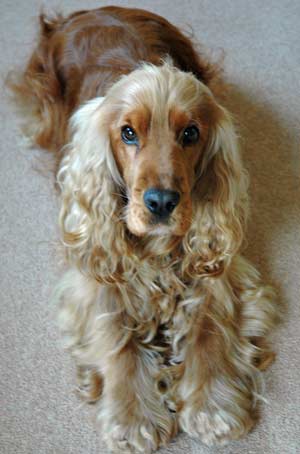
When training a puppy to remain where he is, you might like to use the 'wait' command as follows:
- to stop your cocker from rushing out of the front door
before you,
- to stop him jumping in or out of the car,
- before
crossing the road to allow you time to check if it's safe to cross,
- when you meet people in the street and you want to stop to say hello.
With this command, you'll be teaching your puppy that he must learn to obey you and wait until you give him permission to move.
Your Cocker puppy will learn that whilst in the wait position, he will soon be allowed to move away, but only after you have released him.
Training A Puppy: When To Use The 'Stay' Command
'Stay' is a more formal command and is used when you want your puppy to remain in place, no matter what, until you can go to him.
For example, he may be across the other side of a busy road, one which you don't want him to cross.
In this situation, you would use the 'stay' command as you want him to remain where he is until you can safely get across the road to secure him.
In this situation, the 'wait' command would be ineffective. It just wouldn't work, Your dog may anticipate being called to you and may release prematurely, darting across the road and into traffic.
Your puppy should learn that when he is in the 'stay' position, he must not move away, and that you will go to him, always, before releasing him.
Steps to Training a Puppy to 'Wait'
Try this exercise indoors first, and make sure there aren't any distractions for your puppy, otherwise you may be wasting your time!
- Stand in front of a closed door, but not so near that you can't open it, and ask your puppy to sit by your side.
- Put your hand down by your side, open palm towards your Cocker Spaniel's face (you can use this as your visual 'wait' command when he's by your side).
- Open the door slowly, and give him the 'Wait' command, both vocal and visual. If he moves, close the door and gently move him back to the starting position.
- Ask him to sit, and try the exercise again.
If you use this training exercise at a door that leads outside, take care to have him on a lead just in case he tries to make a dash for it!
- If your puppy stays still for several seconds, walk slowly through the door. As you do so, say his release word, and his name, (for example: 'okay Max') and allow him to follow you.
Give him a treat and lots of praise if he gets it right.
Gradually extend the length of time you ask your puppy to wait.
Later, when you feel he's mastered the wait command, you can practice with distractions to make it more difficult for him.
Training a puppy to use the 'wait' command will help to give your puppy manners.
For example:
- it is ideal to use before feeding him,
- Make him sit and wait while
you prepare his food, and have placed the bowl on the floor.
If he sits and waits patiently you can praise him before releasing him.
If your dog lunges towards the food bowl before you have released him, move him gently back to where he was, and try the wait command again - he'll soon learn that he won't be fed until he obeys your command! - Repeat these exercises about eight times (or more) each training session until
you're confident that he's fully mastered the command.
- When he responds immediately and waits until you release him, he's got it! Now's the time to try using the verbal and visual commands separately. This will confirm whether or not he completely understands.
If he fails, continue with the training, and test him again later.
Did your puppy pass his training test, both verbal and visual, separately?
He did? Then he's ready to move on to the 'stay' command.
Training a Puppy to Stay Put
As I said earlier, 'stay' is the more formal of the two commands and is often used when you need your puppy to stay in one place for a while.
Steps for Training a Dog to Stay
If you follow these steps for training a dog to stay, you will be able to feel confident that your dog will stay sitting (or down) until you release him.
- Call your puppy and ask him to sit.
- Stand directly in front of him, approximately 30 cm away from his front paws.
- Lean forward, and put your hand in front of your puppy's face, palm facing his snout, in the universal stop signal.
- Give your puppy the 'Stay' command and slowly move one step backwards, away from him, but keep your hand in front of his nose.
- If he stays for 5 seconds, step back towards your puppy and praise him with the words 'Stay, good boy stay', and give him his treat.
If your puppy won't stay in one position for that long, you could try rewarding him after 2 seconds and work up to 5 seconds. Don't give your Cocker time to fail! - At your next session, begin gradually increasing the amount of time he's left in the stay position by a few seconds.
- Repeat
this exercise several times each day until
you're are confident that your puppy fully understands what's expected of
him, and why he's being rewarded.
- It's
important when training a puppy to stay, not to move on until he's mastered staying put for at least 60 seconds. When he's done
that you can increase the distance you stand from him until you are at
least 3 meters away.
- Try giving the 'stay'
command to your puppy and then moving out of the room, or out of his
sight, for 30 seconds. If he's still sitting when you return, praise him really enthusiastically and give him a treat.
- Don't praise your Cocker Spaniel until you have returned to him otherwise it may encourage him to run to
you, which is the exact opposite of what you're trying to teach him.
- Don't let him stand up or come to you, otherwise he may believe that he's being rewarded for standing, or for following you. If your puppy does either of those, don't say anything; simply move him back to his starting position and begin again.
- Gradually increase the length of time you stay away, but don't leave him sitting for too long, you don't want him to fail.
Tips For Training A Puppy
Use these dog training techniques and tips as often as you can to strengthen your puppy's learning.
- Experiment with the 'stay' command in different parts of the house and garden, and for varying lengths of time. Eventually, you will be able to leave your puppy for up to 15 minutes, perhaps even more.
- For 'stays' longer than a few minutes, I recommend you ask
your puppy to lie down before you ask him to 'stay' as
it's kinder.
The commands to use are 'Down' and 'Stay'. When training a puppy, we recommend you practice the 'stay' command in both the 'down' and 'sit' position until your puppy has mastered both commands.
- To really test your puppy, try throwing a ball past him while he's in the 'stay' position.
He should remain in a sitting (or down) position until you go to him and release him from his 'stay' command.
When you feel your puppy has mastered the 'stay' command, whether sitting or lying down, try using the verbal and visual commands separately, to see if your puppy has understood.
If he gets it wrong, take a break. You can resume the training later and test him again.
Don't move on to other puppy obedience training until you're certain that he's learned each lesson.
Training A Puppy To Come Back To You
I hope you've found the tips in my training a puppy page helpful.
By now, your pup should have learned the difference between the 'wait' and 'stay' commands, and mastered both verbal and visual commands separately.
If he has, he's ready to move on to the recall command, 'here boy'!
You might like these
How To Train A Puppy
Want to know how to train a puppy? Follow these essential rules of puppy training to help your pup get it right first time!
Puppy obedience training can help keep your new puppy safe!
Giving your puppy obedience training, such as sit, stay, wait, come etc., will help you to shape a well-behaved puppy and will also help to keep him safe.
Top 10 Puppy Training Tips
Does your puppy do as you ask? If he won't listen to a word you say, try these successful puppy training tips and see how much a difference they make!
Puppy Chewing: 10 Ways To Stop Puppies And Dogs Chewing
Is your cute Cocker puppy chewing everything in sight? Don't worry. Our step by step guide will soon stop your Spaniel puppy munching his way around your home!
Photo Credits for Training a puppy to 'Wait' and 'Stay'
1. Copyright of About Cocker Spaniels
2. . Arroz Con Nori at https://www.flickr.com
Recent Articles


-
Want to train your dog to come back to you immediately? Learn how here
Apr 12, 24 12:36 PM
 Teaching your puppy recall is one of the most important things you will ever teach your Cocker. Learn how to train your dog to come back when called.
 -
Want to know how to train a Cocker Spaniel to drop his ball?
Apr 12, 24 12:25 PM
 Train a Cocker Spaniel to let go of whatever's in his mouth, without hesitation, and you won't regret it. This is an excellent command to teach your puppy!
 -
Puppy obedience training can help keep your new puppy safe!
Apr 12, 24 12:13 PM
 Giving your puppy obedience training, such as sit, stay, wait, come etc., will help you to shape a well-behaved puppy and will also help to keep him safe.