- Home
- Puppy training
- How To Stop Your Puppy Biting
Is Your Puppy Biting Too Hard?
Are you fed up with your puppy biting fingers and toes?
Unfortunately, biting is normal behaviour for puppies and can often seem cute at first. However, imagine your pup as an adult dog biting your fingers; not so endearing now, is it?
That's why it's essential to train your puppy to stop biting too hard; he must learn to be gentle and that biting and nipping people is out of bounds.
Puppy Biting? It's What Puppies Do!
Puppy teeth are sharp and needle-like, and they can hurt!
If your puppy is biting and mouthing everything in sight, don't worry, you're not alone.
Your pup isn't aggressive; he's just doing what comes naturally. Play biting and mouthing are normal behaviours for young puppies; it's a natural part of their development, especially in the teething stage.
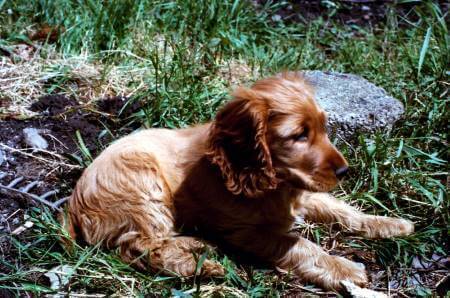 I love being outdoors, Mum!
Biting and mouthing is how they play and explore their new world, but they must learn to be gentle and develop a 'soft mouth'.
This must happen as early as possible because the window closes at around 4 - 5 months. Coincidentally, this is about the same time they get their adult teeth!
If your puppy is chewing furniture, slippers, socks, etc., the best way to deal with it is to redirect his chewing and teach him that he's only allowed to chew on his toys.
What Does Puppy Bite Inhibition Mean?
Puppy bite inhibition is the pup's ability to control how hard (or, more to the point, how gently) the puppy bites. So if your puppy bites hard, read on.
Puppies usually learn to control their biting during play with their mother and siblings.
When the puppy bites its mother too hard, she'll yelp loudly, and she may also bite back. This usually stops her pup in its tracks, unsure of what to do next.
If the puppy bites again, the mother may yelp louder this time. She will also growl or snarl quite viciously at the offending pup. She's letting her puppy know that he is still biting too hard, and it's unacceptable.
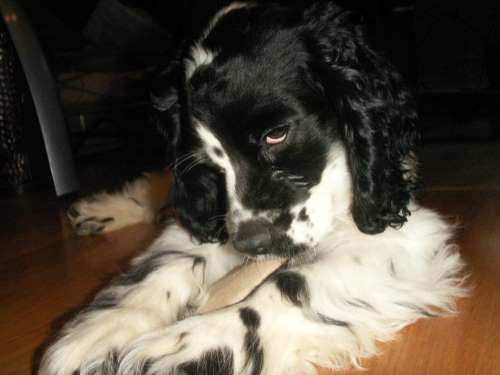 Go away, this is my stick!
She may also turn away and have nothing to do with him for a while, or at least until he's learned some manners.
If her puppy doesn't let up, she may grab him by the scruff of the neck and gently shake him to let him know she means business.
His siblings also play a part in teaching each other not to bite too hard. If you watch puppies playing, you'll see that when one puppy is bitten too hard, it will yelp and move away from the aggressor, and play stops immediately.
And because puppies love playing, the biting puppy soon learns he must be more gentle if he's going to be allowed to play.
How To Teach Your Puppy Bite Inhibition
Being bitten by sharp little puppy teeth can be very painful, so we must help our little boy understand that biting hurts.
Here's how!
- The next time your puppy bites you, yelp loudly and say 'No' in a firm, disapproving tone to let him know that he hurt you.
It's okay to overreact and sound a little more hurt than you actually are; it might even help to get the message across quicker. - Stop playing with your puppy. Simply turn away and ignore him for about 60 seconds, after which you can begin playing with your puppy again.
- If your yelping seems to overexcite your Cocker pup and he bites harder, don't yelp. Just go limp, stay very still, and ignore him; don't even look at him.
- If your puppy isn't getting the message after practising this a few times, try giving him a rubber bone to bite or chew on. This will help convey the message that if he really wants to chew, he should chew his toys and bones and that biting your hands and fingers is not allowed.
- If he doesn't show any interest in his chew bone and bites you again, repeat your loud yelp and 'No' and either move away and ignore him or leave the room for a few minutes. (If you leave him alone, be sure the room is puppy proof and safe).
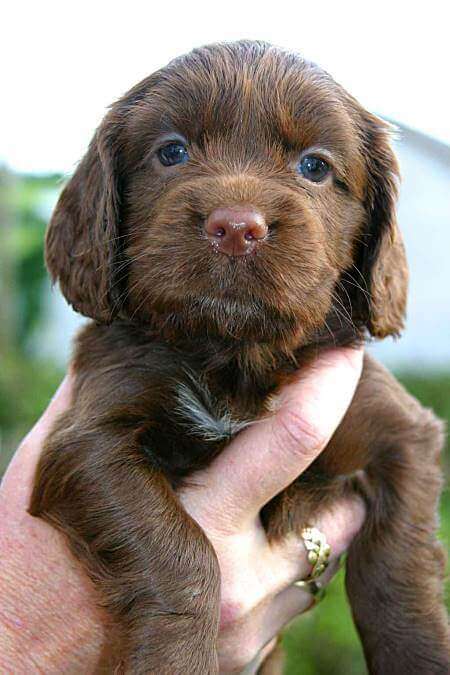 This puppy doesn't bite!
If you practice the above each time your pet indulges in a bit of puppy biting, he'll soon learn that it's wrong and that if he does bite, his play sessions will come to an abrupt end.
This is the same message his mother would give when teaching her pups not to bite. (This is another good reason a puppy shouldn't be taken from the litter too early.)
Your Cocker Spaniel puppy will almost certainly continue to bite (it's what puppies do!). However, the pressure of his bites should now be softer because he will have learned that more gentle biting will allow the fun to continue.
Your aim is to continue to teach him to soften his bite each time until he eventually stops biting altogether.
So, even though your puppy's bite no longer hurts you, continue to yelp, and say 'No' when his teeth touch your hands.
Important Note: If you have an adult dog biting problem, don't try to tackle it yourself; seek immediate help from a qualified dog behavioural therapist.
Your puppy will eventually stop trying to mouth your fingers and automatically stop playing if his teeth accidentally touch your hands.
Teaching your puppy bite inhibition and stopping him from biting altogether can take up to 4 weeks to complete successfully, so please be patient (and consistent!).
If your puppy is teething, make sure he has plenty of safe puppy teething rings and bones. A teething puppy can never have too many chew bones!
Other Methods To Stop Your Puppy From Biting
Several other training methods may help stop your puppy from biting your fingers. Whilst I don't endorse all of them, I've set them out below to allow you to judge for yourself.
Spraying With Water
Spraying your puppy with water (or a mixture of water and lemon juice or vinegar) each time he bites will be unpleasant for him. It won't hurt him, but it will make him think twice about biting you!
Holding Your Puppy's Jaw
The next time your puppy bites you, you could try placing your thumb into your puppy's mouth, under his tongue.
At the same time, hold the underside of your puppy's chin with your fingers. Don't be too rough with him, though; hold this position for around 15 seconds.
This won't hurt your puppy, but it will stop him from being able to bite you.
Nasty-Tasting Hands And Fingers
There are products on the market that, when sprayed onto your hands and fingers, your pet won't like the taste, and it will put him off biting and nipping.
There are many products to choose from, and one, in particular, is said to be very effective. It comes in a spray and tastes of bitter apples.
Using A Choke Collar
Some people advocate using a choke collar to stop a puppy from biting. The choke collar is pulled sharply each time the puppy tries to bite. The painful and unpleasant negative association teaches the puppy not to bite.
Personally, I have never used this method. I believe it's a cruel practice and would definitely not recommend it.
I'm sure none of my visitors to this site would, either.
The Shake Method
Another method uses a tin can with a few pebbles, coins, or dried peas taped inside.
Each time your puppy bites, say 'No' in a firm tone and, at the same time, shake the tin can. It will make such a racket that it startles the puppy into immediately stopping what he's doing.
Dogs don't like this rattling sound and will respond quite well. However, my research shows me that this 'shake method' should only be carried out by experienced trainers.
So, before considering trying this, I strongly recommend that you take professional advice from a qualified dog behaviourist.
The Scruff Method
The 'scruff method' is where you grab the puppy's scruff (the loose skin on the back of his neck), pretty much like his mother did when her puppy misbehaved.
Next time your puppy is mouthing you, yelp and say 'No' and, at the same time, grab the scruff firmly.
Don't shake, pull or rag your puppy; simply hold the scruff for a few seconds before letting go and giving your puppy a chew toy to bite on.
Puppies and Biting: Do's and Don'ts
Here are a few puppy biting tips, I hope they inspire you!
- Do repeat the training often because it can take many repetitions before your puppy understands what you want from him.
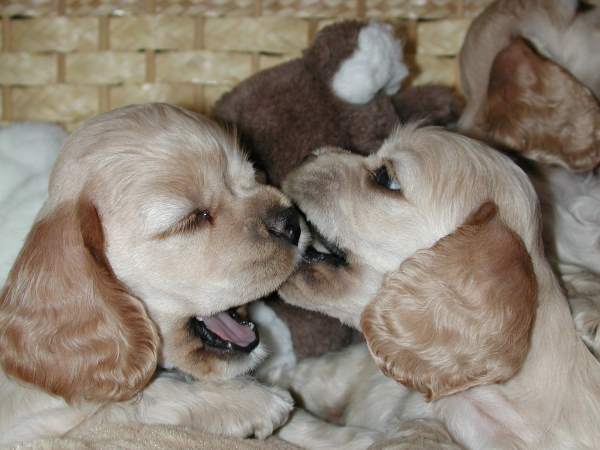
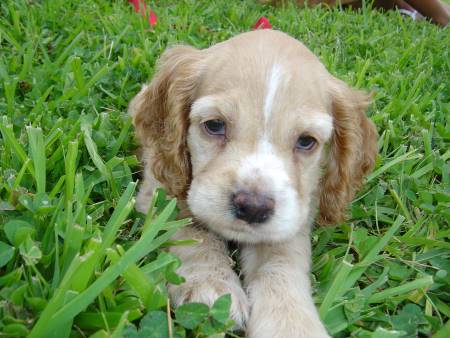 Hello Mummy, I'm sorry for biting you!
- Do be consistent when teaching your pet not to bite. Explain your training method to each family member and ensure they follow the same process.
- Do let visitors know you won't tolerate it if your puppy bites anyone; biting is not allowed. Explain (and show them) how you handle a biting puppy so they can follow suit, if necessary.
- Do ensure that young children are supervised at all times when playing with puppies. Kids and puppies can play rough!
- Do praise and reward your puppy when he gets the training right and when his behaviour is good. This will help to teach him that you approve of what he's doing and help reinforce his good behaviour.
- Don't play rough games or tug-of-war games with your puppy until your puppy has learned the 'Leave It' and the 'Drop It' commands and you're confident that he will stop and let go when you ask.
- Don't allow your Cocker Spaniel puppy to get away with biting and nipping; otherwise, he will continue to bite, and an adult dog that bites is dangerous.
- Don't smack your puppy for nipping or biting. If your Cocker puppy is sensitive (and many Cocker Spaniels are), you may hurt and scare him, making him afraid of you.
Conversely, he may think you're playing with him if he's not so sensitive or is a dominant puppy. As a result, his 'game' may become more aggressive; he may bite you even harder. - Don't despair; follow the advice given on this page and keep at it; you will get there.
Puppy Biting: Summary
If you follow the above advice carefully and consistently, you will stop your puppy from biting; it may just take a bit of time and patience.
However, if your puppy continues to bite and/or appears aggressive, growls, or snarls, please take your puppy to see his vet and explain what you have tried.
If your vet confirms that your puppy is healthy and sees no underlying problems causing your puppy's aggression, he may refer your puppy to a dog behaviourist.
Visitor Questions:
How Can I Stop My Puppy Biting?
By: Amanda
From: United Kingdom
Hello, I have a problem with my young puppy, who is one month old and bites!
She bites everyone all the time; she bites shoes, hands, clothes, hair....everything!
I love my puppy, but she's driving me mad. What can I do to get her to stop?
Reply from Pauline (Web Owner)
Hi Amanda,
I'm afraid all puppies bite but don't worry; we can help you get through this.
I have answered your question above in this article, but let me summarise it for you.
If your puppy had remained with her litter, her mother would have taught her not to bite too hard. However, as you are now her 'mother', that job falls to you.
So, the next time your puppy bites you, gently touch the end of her nose (not smack) and just say 'No!' in a loud, firm voice, stop all play and move away from her.
At the same time, squeal to let her know she's hurt you. You could also move away and ignore her.
These tactics will teach your puppy that biting using too much pressure hurts humans and is not acceptable.
Worst of all for her, there's no more playtime!
Here is a reminder of the do's and don'ts to help you stop your puppy biting:
- Always reprimand your puppy each time she bites.
- Don't smack your puppy for biting.
- Do repeat the above advice whenever your puppy bites.
- Ensure all the family react in the same way when your puppy bites.
- Ensure visitors understand what they need to do if your puppy bites them.
- Supervise children and watch them at all times when playing with their puppy.
- Don't forget to give your puppy lots of praise when she gets it right.
- Don't play rough, and (for now, at least) don't play tug-of-war games. You can learn why here.
It's up to you now. Do lots of practice, have patience and good luck, Amanda!
Visitor Comments:
Pup Biting
By: Gill
Hi, I have a little tip for you.
The yelping I was taught to help stop my puppy biting didn't work; instead, he took it as an invitation to bite some more!
But, a tip I learnt from a book was to teach him 'kisses'. This involved putting flavoured lip balm on my arms/face/legs, and he would learn to lick that. And when he did, you told him 'kisses'.
He never bites now, so it was a good tip! Anyway hope this helps just a wee bit.
Good luck, and enjoy your puppy as they grow up so quickly!
Read more about helping to stop your puppy biting.
Photo Credits: Puppy Biting
1. Nicholas Smale at https://www.flickr.com/photos/nicholassmale/2650404897/
2. J Todd Poling at https://www.flickr.com/photos/bigdog3c/2169314193/in/album-72157594576211598/
3. Rob Waterhouse at https://www.freeimages.com/photo/sussex-spaniel-puppy-2-1386954
4. Sher371 at https://www.freeimages.com/photo/waiting-1552812
Recent Articles


-
Is Your Puppy Teething? How to help ease your new Cocker's pain!
Jul 10, 24 07:07 AM
 Is your cute puppy getting his first set of baby teeth? Find all you need to know about puppy teething to help your Cocker Spaniel through this difficult phase.
 -
What you eating?
Jul 02, 24 05:09 AM
 This is my Chocolate Merle Cocker Spaniel. He's a hyper-energetic boy who's always on the lookout for food!
 -
Want to train your dog to come back to you immediately? Learn how here
Apr 12, 24 12:36 PM
 Teaching your puppy recall is one of the most important things you will ever teach your Cocker. Learn how to train your dog to come back when called.