- Home
- Cocker Spaniel training
- Stop your dog from barking
How To Stop Your Dog From Barking
Want to know how to stop your dog from barking?
Excessive dog barking can quickly become a nuisance if it's not addressed. However, you need to understand why your dog is barking before you can begin to address the problem. More often than not, if you remove the situation, he'll stop barking. It's as simple as that... well, almost.
Discover 5 effective methods to stop dogs barking below.
Why Do Dogs Bark?
It's a fact of life - all dogs bark from time to time!
Dog barking is a natural canine behaviour; it's how they communicate.
A bark can mean anything from 'Let's play, I'm hungry, or I'm bored' to a warning of potential danger - 'Hey mum, there's a prowler outside!'

But when your dog's barking continues incessantly, it can become a real problem for you and your family, not to mention your neighbours!
Your Cocker Spaniel should be allowed to bark to inform you of pending danger or alert you to a problem. However, once he has 'sounded the alarm', his barking should stop. Period. Because nobody likes excessive dog barking.
Don't allow your dog's barking to become a problem because once your Cocker Spaniel has gotten into the habit of barking, it can be challenging to stop.
Stop Your Dog From Barking: Remove The Cause!
You can often stop your dogs barking simply by removing what's upsetting him.
Remove the problem, and you'll likely stop your dog barking. For example:
- If your Cocker Spaniel is bored or lonely, make sure he gets lots of exercise, has plenty of toys to play with to keep him occupied, and has regular training and mental activity;
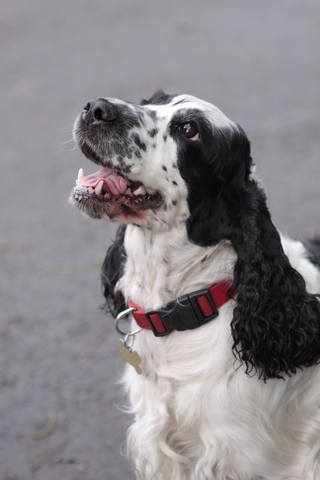 Listen to me Mum, Woof!
- If you think he senses a prowler outside (even if it's just next door's cat!), put the exterior lights on and check there's no one around. Putting the lights on is usually enough to frighten off most intruders (including the cat!), which in turn will stop your dog from barking;
- If he's being teased by the kids and he's becoming frustrated, stop the children teasing him, and your dog will stop barking.
- If your dog is hungry, feed him!
Tired, well-fed and watered, contented Cocker Spaniels are happy dogs, and happy Spaniels don't nuisance-bark!
Why Is Your Dog Barking?
In the above examples, it was the causes of the dog barking that needed to be addressed, not the barking itself.
It's often easier to work out what's causing your dog to bark and remove the cause than to stop your dog from barking with commands or even, let's face it, begging!
However, where the cause can't be removed, you must find other ways to address it.
A dog barking for a prolonged period usually means something is wrong, and he's trying to let you know.
 I used to bark a lot but not anymore!
Suppose you can't work out why your dog is barking, but you're confident he's not ill or injured. In that case, it's possible his barking has become a habit (as unsociable and annoying as that is), and he's barking simply for the sake of it.
Incessant dog barking is excessive and unnecessary. It is the kind of barking we want to discourage, especially before it becomes a habit.
If your Cocker has developed this annoying habit, take a look at some of the methods below that you can use to help stop your dog from barking.
5 Effective Methods To Stop Barking Dogs
1. The 'Be Quiet!' Command
One of the best and easiest remedies to stop your dog from barking is to teach your dog to bark and then teach him to stop.
Yes, it does sound contradictory, doesn't it? But I promise you, it works.
This method of stopping a dog from barking works best if it's taught to a puppy before it discovers the joy of barking. However, it can be introduced to an older dog, but it may take slightly longer.
If this sounds right to you, follow the link to learn how to teach your puppy to 'Be Quiet'.
2. Other Methods To Stop Your Puppy Barking
If you have a puppy with an excessive barking problem, and the above simply isn't working for you, you may find the exercises in this article, 'How To Stop Your Puppy Barking', very useful to help you nip it in the bud.
Many of the methods used also work with adult Cocker Spaniels.
3. How To Stop Your Dog From Barking At Visitors
Sometimes our dogs bark at visitors because they're over-excited or believe the visitor is a threat to their pack.
Suppose your dog barks at visitors, delivery men, garbage collectors, or the postman. In that case, you can follow the link for some great ideas to help your dog overcome his barking habit.
4. How To Stop Your Dog From Barking In The Garden
Most Cocker Spaniels enjoy being outdoors. Unfortunately, some become barking demons as soon as they're allowed into the garden.
Vocal pets can sometimes drive you (and your neighbours) to distraction, barking at everything from birds and rustling leaves to their own bloomin' shadow!
'Barking Mad In The Garden' will help you to stop your dog barking outside, and in no time at all, you and your neighbours will once again be able to enjoy the peace and quiet of your own yard...ah, bliss!
5. Dog Barking Deterrents
Many owners recommend using a barking correction collar on their dogs, usually because all else has failed.
A correction collar is a device worn around the dog's neck which triggers a spray or a mild current each time your pet barks.
The aim is to teach the dog that something unpleasant (but not harmful) will happen each time he barks. This unpleasant experience will make him think twice about barking again, and eventually, he will stop barking completely.
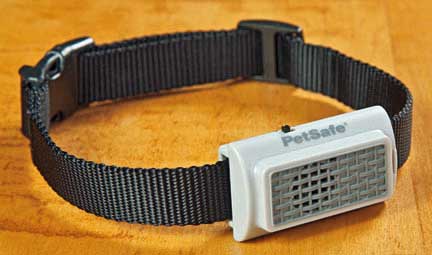 Barking correction collar
One of the downsides to a correction collar is that another dog's barking can set it off.
If you're on a tight budget, a simple and cheap alternative to the correction collar is a water spray. You can use an ordinary toy water pistol or garden spray bottle; simply fill it with water or water and lemon juice.
The problem with a spray that you activate is that he can only be 'punished' for barking when you're around; if he barks when you're not around, he won't be sprayed, which results in inconsistency, making this method slightly less effective.
You can learn more about dog barking deterrents here.
Punishment Based Methods
The methods listed below follow a punishment-based approach (and/or are a last resort) to prevent a dog from barking.
I've known of and seen many owners employ these 'tactics'; however, I believe they're harsh and rather drastic.
Judge for yourself.
- Removal of the vocal cords (Vocal Cordectomy or Surgical Debarking). This 'remedy' is only used in extreme situations where chronic barking simply cannot be controlled.
The operation doesn't usually remove the bark altogether; it simply reduces it to a hoarse croak. However, the noise levels are considerably reduced. - Some frantic owners have actually resorted to taping their dog's muzzle closed! This is cruel, and I certainly don't recommend it. I do not recommend using a dog muzzle to stop dog barking.
- Smacking the underside of the dog's muzzle every time he barks - I don't think so. However, it's said to work like the correction collar.
- Staring into the eyes of a barking dog until the barking stops and the dog goes into 'submissive mode'. This is an unsafe practice and certainly not recommended!
- Muzzling their dog. Although this may stop a dog barking, it won't stop him from being vocal. Using a muzzle in this way is cruel. It's not what muzzles are made for. There are other more suitable methods available.
- A tin can, or a bottle, containing pebbles or coins is shaken vigorously each time he barks. Dogs don't like the sound it makes.
- Although the rattle bottle may work, I don't recommend using this method without seeking professional advice from a qualified canine trainer or animal behaviourist. It could make your pet aggressive if not appropriately used.
- Whacking your dog on the nose with a rolled-up newspaper when he barks? I don't think so!
I believe these methods are a little over the top as they are too aggressive, and I would never recommend any of them.
Apart from being harsh (and, in some cases, downright cruel!), they're only short-term 'solutions' as they'll only work when you're near enough to your pet to give the 'correction'.
Reward Based Methods Are Best
Wherever possible, I recommend you avoid the negative, punishment-based approaches shown above and use positive, reward-based training methods instead.
Use punishment-based training methods at your peril.
If you do, you may end up creating other behavioural problems in your Cocker Spaniel, for example, biting or aggression, particularly towards the person giving the punishment - you.
"Reward-based training is much more effective and kinder to your dog than negative, punishment-based training."
Let's look at it from your dog's point of view.
When the postman or a delivery man comes to the door, your dog begins barking to let you know someone is outside the door, and your dog is whacked for barking. No matter whether he's smacked with a newspaper or something is thrown at him, he feels pain each time.
It won't be long before he begins associating his pain with visitors to your home, which could eventually make him aggressive towards the postman, or worse, all visitors.
Our dogs learn by association.
If you give your pet a (reward-based) correction, you will need to 'catch him in the act' so that he understands why he's being corrected. I'm talking seconds here. Leave it too long, and he won't make that connection.
Acknowledge your dog's bark (he's saying you have a visitor), and then ask him to be quiet. Let him see the treat in your hand and if he stops barking, reward him.
If you reward your pet the moment he stops barking, he'll soon learn that when the postman arrives, it's treat time, and the postman is no longer a threat.
Result!
Acknowledge Your Dog's Barking
Always acknowledge your Cocker Spaniel's barking. Let him see that you understand what he's trying to tell you.
For example, if he's barking at the door or the window, go and take a look. Tell him it's okay, praise him and lead him away if there's nothing to be worried about.
 I'm a good boy, I don't bark...much!
Be consistent. Choose words you feel comfortable using and stick with them. If you've taught your dog the "Be Quiet" command, use that but add something like, it's okay, or we're safe.
As you're reassuring your dog, take hold of his collar, gently guide him back to where you were sitting, and give him a pat.
In your dog's eyes, he's let you know there was a potential problem, and you (as his pack leader) have investigated. You have decided that there was no danger. You have acknowledged his warning.
If you don't investigate the problem, his barking will continue, probably even louder, so ignore it at your peril!
Is Your Dog Barking For Attention?
If there's a possibility that your Cocker is simply barking for your attention, you could be making matters worse by fussing over him when he barks.
Giving your dog attention when he 'demands' it by barking will just confirm to him that his barking gets him exactly what he wants. He'll soon learn that his barking works and will do it all the more when he wants something else from you...because it works!
Before you decide your Cocker Spaniel is barking for attention, ask yourself whether or not you're spending enough time with him:
- Do you give him enough exercise?
- Do you play with him?
- Is he bored?
Your Spaniel needs at least an hour's walk and 15-20 minutes of play each day to burn off energy, more if you have the time.
Wear him out!
Reward him with your attention and praise only when he's quiet and well-behaved to encourage and reinforce his good behaviour.
If Your Dog is Barking, Don't Shout At Him!
The worst thing you can do to stop your dog from barking is to shout at him. It just won't work.
Unfortunately, as frustrated dog owners, this is sometimes exactly what we do!
When you shout at your dog to stop barking, all he hears is a human 'woof-woof'. He thinks you're barking too; you're joining in the fun!
Shouting at your dog will only encourage him, usually louder and more determined!
If all else fails...
If, after trying some of the above methods, you still haven't managed to stop your dog from barking, I recommend you consult your vet.
If your vet gives him the all-clear, perhaps you should consider contacting a professional trainer or animal behavioural therapist for advice.
The vet or behaviourist might suggest that your Cocker stays with them for a few days. This will allow them to monitor your dog's behaviour for themselves before deciding which is the most suitable therapy for your dog.
Alternatively, they may prefer to work directly with you and your pet to devise a strategy to stop your dog from barking.
A professional will help you communicate better with your pet and solve the barking problem.
Either way, it's a win-win situation, don't you think?
Photo Credits for Stop Your Dog From Barking:
1. Copyright of About-Cocker-Spaniels.com
2. ID 14759201 © Ks2008q | Dreamstime.com
3. Copyright of About-Cocker-Spaniels.com
4. Unknown
5. Unknown visitor to website
Recent Articles


-
Is Your Puppy Teething? How to help ease your new Cocker's pain!
Jul 10, 24 07:07 AM
 Is your cute puppy getting his first set of baby teeth? Find all you need to know about puppy teething to help your Cocker Spaniel through this difficult phase.
 -
What you eating?
Jul 02, 24 05:09 AM
 This is my Chocolate Merle Cocker Spaniel. He's a hyper-energetic boy who's always on the lookout for food!
 -
Want to train your dog to come back to you immediately? Learn how here
Apr 12, 24 12:36 PM
 Teaching your puppy recall is one of the most important things you will ever teach your Cocker. Learn how to train your dog to come back when called.



%20barking%20at%20me%20in%20the%20garden.%20He%20wanted%20to%20play%20but%20I%20was%20whacked!%20I'd%20been%20playing%20ball%20with%20him%20for%20nearly%20an%20hour%20-%20he's%20tireless!)