- Home
- Grooming a Cocker Spaniel
- Brushing a dog
Brushing A Dog Like A Pro!
Brushing a dog once or twice a week is usually enough to keep tangles and matting to a minimum, but sometimes we don't brush as often as we know we should (we have busy lives!), and stubborn tats and matting develop.
Learn how to brush a dog like a professional, remove mats and tangles and prevent them from forming in the first place.
Brushing A Dog
Cocker Spaniel coats have medium to long, fine, silky hairs on the top of the body and a short downy-coat underneath.
It's essential to keep the fine topcoat well-brushed, tangles and tats brushed out, and it's crucial to remove any dead and loose hair from the undercoat to help prevent matting from forming.
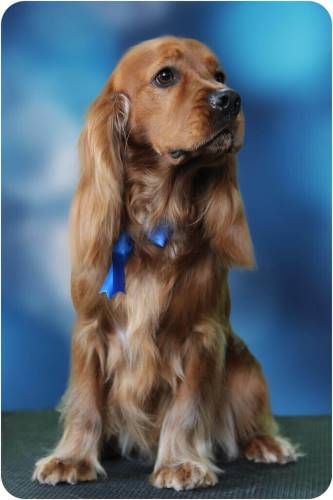 Brushing a dog keeps the coat shining!
Brushing your pet is essential not only to his appearance but to his well-being too.
Who'd have thought it?
Brushing A Dog: How Often is Best?
Most Cocker Spaniels need to be brushed at least every three days to keep them looking good, although if your dog is walked in the countryside, you may need to brush him more often to remove grasses and burrs.
Cocker Spaniel coats have medium to long, fine, silky hairs on the top of the body and a short downy coat underneath.
If you're not sure how often you need to brush your Cocker, begin by brushing his coat once every three days. If the brush collects lots of loose hairs, increase the grooming to every day or every other day.
If there's not much hair on the brush, you can probably reduce brushing your dog to once or twice a week.
Generally, brushing your pet's coat a few times a week will help keep it looking beautiful and glossy!
Grooming A Puppy
It's a good idea to begin brushing a dog when he's very young.
Although a young puppy won't have any feathers yet, going through the motions will help acclimatize your Cocker puppy to being brushed and groomed.
It will also help your puppy get used to being handled, and when it's time for 'big boy brushing', there'll be no surprises!
 I'm getting used to being brushed...I think!
If you want to groom your dog to a professional standard, you'll need a good selection of grooming tools, but don't stint, buy the best you can afford.
Quality tools will do a better job, but they'll last longer too!
Brushing A Dog: Keep Tangles and Mats At Bay
Brushing a dog often will help keep mats and tangles to a minimum.
Areas most prone to problems are your dog's 'arm pits', behind his ears, around his bottom, leg feathers, and chest. I guess that just about covers your whole Cocker, doesn't it?
Sorry, I missed in between his toes. Keep a close eye on this area!
If your dog's coat gets in a tangle, take one area at a time and, using a metal comb, gently tease out the knots.
Start from the ends of the hair and slowly work up towards the skin. This should remove most tangles without too much effort.
Whether you're brushing out tangles, tats or mats, hold the base of the hair firmly (close to his skin) so that you're not actually pulling his hair or hurting him.
I'm sure I don't need to state the obvious, but I'm going to anyway.
Be very gentle when brushing a dog. Of course, no Cocker owner will deliberately hurt their baby, but pulling away at tangled hair won't be much fun for him.
If you're gentle and 'coo' to him while you're working, he's more likely to stay still for longer and will come to enjoy being brushed.
That's the easy bit (well, it is if your Cocker will sit still). Now let me explain more about matting!
What Is Matting?
Not everyone is sure what matting is, so I will explain it here.
Matting is a thick, lumpy felt-like material.
It's basically fur from the dog's undercoat, which has loosened as part of the natural shedding process.
If it's not brushed out regularly, these loose hairs stay in his coat and eventually become matted and lumpy.
Mats are caused by friction, and if your dog wears a harness, he may be more prone to matting in areas where the harness rubs across his coat, so it's a good idea to check after removing your Cocker's harness.
It will only take a couple of seconds and allow you to deal with them before they develop into monster mats!
Mats are easily missed (especially when they form in awkward places), so it's unlikely that your pet will ever be entirely free of them.
Grass, seeds, and burrs can become trapped and make 'matters' much worse (if you'll pardon the pun!).
Once they're embedded, the sharp edges of grass seeds can often work their way into your dog's skin, causing irritation, pain and eventual infection.
If your Cocker Spaniel isn't a townie and is walked in the countryside, I recommend you check his coat for any signs of burrs and plant material as soon as you return home.
Once spotted, remove them straight away before they get a chance to work their way into your dog's skin. (Under the armpits is a 'favoured' spot!).
Brushing a dog's coat often will help keep matting to a minimum, but if you should discover a large mat, here's how to deal with it.
How To Remove Matting
It's advisable to remove any matting as soon as you discover it, or it will continue to get bigger and denser.
Matted fur creates warm, moist areas next to your dog's skin, ideal for bacteria and yeast. Increased levels of yeast and bacteria can lead to irritation, infection and sores.
If your dog's coat is heavily matted, tackle as many as you can in one 'sitting' and then let him rest for a while.
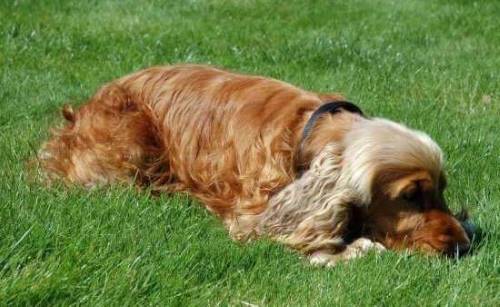 Max chilling in the garden after being brushed
If you try to comb them all out at once, your Cocker may become anxious or fidgety, and he may not be too happy about sitting so still next time around!
Just work on one mat at a time, brushing your dog slowly, carefully, and gently.
If the mat is not too tight, you may be able to pull it apart with your fingers to loosen the hair and then gently comb it out with a metal comb.
If the mat gets wet, it won't help as it can tighten even more as it dries, so it's best to remove mats before you bathe your dog.
You can buy specially formulated detanglers (like the conditioners we use on our own hair) that claim to loosen mats. I've yet to find one that really works, but I'll let you know if I do.
If you decide to try a detangler, leave the product on the mat for a while and then tease it out with a de-matting comb or the prongs of a steel comb.
The slicker brush can remove small mats by gently pushing the pins into them and moving the brush side to side in a rocking motion. Repeat this several times to loosen the matting before trying to brush it out.
Be careful to keep your hand between the mat and your dog's skin so that you don't hurt him. Remember, if you hold the strip firmly at its base while brushing, you won't pull your dog's skin.
If it's a really stubborn mat, it may be necessary to cut it into 'strips' with sharp hair scissors.
Be very careful, don't cut too far into the matting, or the tips of the scissors may accidentally cut into your Cocker's skin!
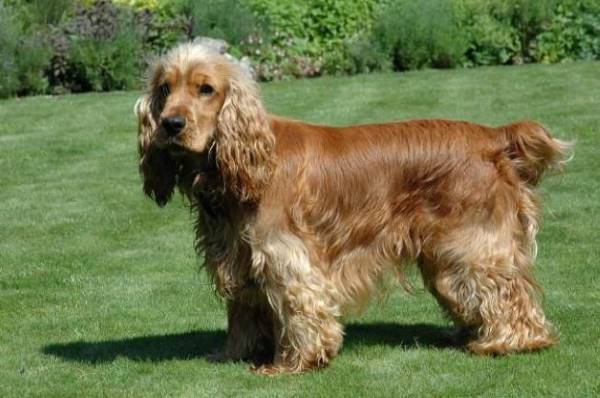 Where are those pesky squirrels?
Then, you can gently brush each strip with a pin brush or a steel comb.
If cutting the mat into strips doesn't work, you may need to cut it out completely.
If you need to cut out an entire mat, don't cut across it with scissors because it's too easy to slice open your dog's skin. A cut like this, across his skin, would very probably need stitches.
Instead, slide the blade down the hair in the direction of growth, away from the body.
This will give the hair a more natural appearance when the mat has been removed and will be safer for your Cocker.
If you're not too confident about removing a mat with scissors, why not take your dog to a professional groomer and have them cut it out for you?
Phew! I didn't realize that brushing a dog could be so dangerous!
Brushing A Dog's Ears
Cocker Spaniel Ears Can Be Problematic
Cocker Spaniel ears are beautiful, but there is a downside.
Their pendulous design often means that their ears trail across the ground through all sorts of undesirable muck, and no food bowl I've ever found stops them from falling into their dinner!
This means that your Cocker Spaniel's ears are often prone to infections, which can be hard to get rid of and cause your pet considerable pain and discomfort.
It's essential to keep your Cocker Spaniel's ears clean, healthy and free from infection.
Brushing A Dog's Ears For Best Results
When brushing a dog's ears, it's advisable to remove any tangles or matting under and behind the ear before you begin brushing the leathers.
Be very gentle with your dog's ears as they can be sensitive.
Cockers tend to have a lot of fur around the inside opening of their ears (and just beneath), preventing fresh air from reaching the ear canal.
Poor air circulation creates a moist area where bacteria can thrive.
Following a severe ear infection in my Cocker (which seemed to take an age to diagnose and treat successfully), I now trim away the hair as best I can to help get the air circulating. This link will explain how to remove this hair.
For the leathers, I recommend you first use a slicker brush on each side to remove as much loose hair as possible.
I usually sit on the floor and lay my Cocker's ear across my thigh, hold the top of his ear (gently) to help stop any pulling sensation, and then brush the ear across my leg (just make sure you're wearing sturdy jeans!)
I find it much easier to brush his ears this way, and Max is content to lie there and let me get on with it.
Once each ear has been brushed thoroughly on both sides, I use a comb to remove any stubborn undercoat. Always begin from the bottom tip of your dog's ear and slowly work your way up.
I'm always surprised at how much more there is, even after using the slicker brush!
Tips For Brushing A Dog
Brushing a dog should be fun for you both.
Don't rush the job; take your time and be very gentle, or your pet will come to resent his grooming sessions.
- If you stay on top of mats and tangles, it will become much easier and more enjoyable for the both of you!
- If you intend to show your Cocker Spaniel, you will need to hand-strip his coat or use a stripping knife.
Your dog groomer can show you how to do this, or if you prefer, will do it for you (at a price!)
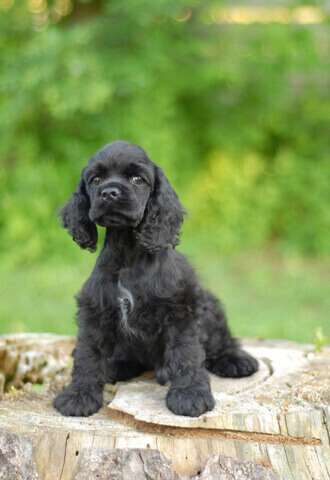 I'm the King of the castle up here!
- Brushing a dog can be carried out on the floor or on a table. It all depends on how your pet behaves and what suits you better.
- Personally, I like to brush Max on the floor when he's lying quietly on the rug, either after a long walk (when he's too tired to protest!) or when he's sleepy at night.
- If you suffer from back problems, your preference may be to brush him on a raised surface. It's much easier on the back, and you can get the brush into all those nooks and crannies more easily.
- However, he's not too keen on being on a table and won't stand still for very long!
- If you're brushing a dog on a raised surface, such as a table, place a rubber mat or a non-slip bath mat onto the table to prevent your pet from slipping (it will also protect your table!) and never leave him unattended.
- When working with a pin brush or a comb, begin at the end furthest from your dog's skin and brush small sections at a time in the same direction that the fur grows, gradually working your way up towards the skin.
- While you work, quietly check for fleas or dog ticks - don't wait for the tell-tale signs of scratching and flecking (is that really a word?).
- Work your way along one side, from head to tail, and then brush the other side, taking care to reach and remove any dead undercoat, which will help to stop mats forming in the first place.
- If your Cocker Spaniel behaves well, reward him with praise while you work, and offer him an occasional treat.
If your Cocker's coat isn't shining, it could be a sign of an underlying illness, a sign of worms, or the sign of a poor diet.
If you're at all concerned about the condition of your dog's coat, take him to see his vet for an accurate diagnosis and professional treatment.
Benefits of Brushing a Dog
There are many benefits of grooming your Cocker Spaniel, and we're going to take a look at some of them here.
Grooming Your Dog Is Relaxing and Rewarding
Brushing a dog can be a calming experience for you and your Cocker, especially after an energetic ramble in the countryside.
Aside from keeping your dog's coat clean, shining and mat-free, it can also help to strengthen the loving bond between you!
Brushing your dog may sometimes seem hard work, but the results are certainly worth the effort. Just look at this freshly groomed Cocker Spaniel. Isn't she beautiful?
Grooming your dog is a relaxing way to spend quality time with your Cocker Spaniel!
Brushing Helps to Circulate Natural Oils
Frequent brushing also helps to spread natural oils evenly throughout your Cocker's coat, helping to keep it soft and shining.
These natural oils help to keep his skin looking healthy too. Just make sure you don't bathe him too often, or you may strip the oils from his coat.
Brushing Your Dog Prevents Tangles and Mats
Brushing your Cocker Spaniel twice a week will help keep tangles and mats to a bare minimum.
It will also help remove dirt and any vegetation that may have been picked up during his walk, such as grass seeds, burrs, leaves, twigs, etc.
If your Cocker Spaniel is anything like mine, he'll often look like he's been dragged through a hedge backwards after his walk. (Which, of course, he usually has!).
Seeds or other plant debris are a nuisance because if they're left in your dog's coat, they will almost certainly cause matting, so it's a good idea to check him straight after his walk and remove what you can there and then.
Seeds or plant spines trapped inside the matting can work into your dog's skin (especially under the 'armpits'). This can lead to inflammation and infection and may result in another (costly) trip to the vet's surgery!
I've had a couple of close calls where I'd missed the seed (2 cm long!), and it had pierced Max's skin (under his pits).
I carefully cut out the mat, and there it was, half in and half out of his skin. I gently pulled it out, but unfortunately, inflammation and infection had already taken hold.
I cleaned it up and applied an antiseptic cream (re-applying it twice a day and keeping a watchful eye on it), and it cleared up all on its own, in no time at all!
That's what I call a lucky escape!
Brushing a Dog Helps to Minimize Shedding!
Brushing your dog's coat will help remove dead and loosened hair, which would otherwise end up on your carpet (or best black trousers).
Brushing can help to keep shedding to an absolute minimum.
Benefits of Brushing a Dog: Summary
Generally, it's best to brush your Cocker Spaniel at least every couple of days to keep him looking good, although if you walk him in the countryside, you'll probably need to brush him more often.
This will help keep tats, knots, and matting to a minimum.
Brushing your pet is an ideal time to examine your Cocker Spaniel for skin problems and to see if there's any sign of dog fleas or ticks.
Brushing can help to improve your dog's circulation and help keep his coat looking good for longer.
Above all, brushing a dog should be therapeutic, not traumatic.
The act of brushing is relaxing and calming for both owner and dog and can help you bond more closely with your Cocker Spaniel.
Enjoy it!
Photo Credits: Brushing a Dog
1. Tehzeta at Flickr.com - https:www.flickr.com/photos/tehzeta/4966383725 (Melissa Thereliz)
2. Olga Chernetskaya at https://www.dreamstime.com/stock-images-puppy-cocker-spaniel-image18581224
3. About Cocker Spaniels
4. About Cocker Spaniels
5. Tammy McAllister at https://www.dreamstime.com/royalty-free-stock-image-american-cocker-spaniel-puppy-image5436306
Recent Articles


-
Want to train your dog to come back to you immediately? Learn how here
Apr 12, 24 12:36 PM
 Teaching your puppy recall is one of the most important things you will ever teach your Cocker. Learn how to train your dog to come back when called.
 -
Want to know how to train a Cocker Spaniel to drop his ball?
Apr 12, 24 12:25 PM
 Train a Cocker Spaniel to let go of whatever's in his mouth, without hesitation, and you won't regret it. This is an excellent command to teach your puppy!
 -
Puppy obedience training can help keep your new puppy safe!
Apr 12, 24 12:13 PM
 Giving your puppy obedience training, such as sit, stay, wait, come etc., will help you to shape a well-behaved puppy and will also help to keep him safe.