- Home
- Cocker Spaniel Puppy Care
- Bathing a puppy
Bathing a Puppy for the First Time: How To Keep Your Puppy Happy At Bath-time
Bathing a puppy for the first time can be a scary experience for you both, and the last thing you want to do is traumatise your puppy, right? Please don't make the mistake of dumping him into his bath and hoping for the best; chances are you'll frighten him to death!
Follow our ultimate guide to bathing your puppy so he enjoys his first-ever bath time.
7 Simple Steps For Bathing A Puppy
Giving your puppy's first bath some thought beforehand is advisable.
If bathing your puppy for the first time, you must take it slowly; otherwise, you may frighten your pup. The whole idea is to make your puppy think that bath time is fun!
Follow these seven easy steps, and your puppy will look forward to being bathed in no time!
Step 1: Place Your Puppy In An Empty Bath
It's better to begin bathing your puppy in the family bathroom (rather than the kitchen sink) because he won't always be this small and may not fit into the sink.
You should get him used to being in the bath at some point; it may as well be now. Remember to put a non-slip bath mat into the bottom of the bath first so that he doesn't slip and slide, as this could frighten him before you even begin!
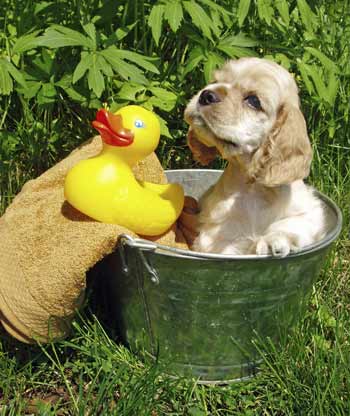 I love my little duck!
Don't run any water into the bath at this stage; this exercise aims to get your puppy used to being inside an empty bath.
If he seems relaxed and isn't upset, give him a small treat and tell him he's a good boy. Let him play with his favourite toy for a couple of minutes, but don't worry if he's not interested. Allow him to explore the bath if he's curious.
You can make it more fun for him by running your fingers along the bottom of the bath, tapping your nails as you go, tickling him gently under his chin or stroking his ears; anything to keep his mind off being in this big scary white thing!
If your puppy tries to get out of the bath or cries, don't reassure him (otherwise, he'll think there IS something to worry about); distract him with a couple of treats and more play, and continue telling him he's a good boy.
Why not climb into the empty bath with him for the first couple of sessions? He's more likely to concentrate on you rather than his being in the tub.
Your goal is to have your pup play happily inside the bath for a couple of minutes to help him understand that no harm will come to him; bathing a puppy is meant to be fun!
Practice this daily until your puppy is completely relaxed and happy in the bathtub.
Step 2: Bathing A Puppy: Get Him Used To The SOUND of Running Water
Once your puppy is relaxed about being in an empty bathtub, your next step is getting him used to the sound of running water.
At this stage, don't run the water while he's in the bathroom, as the sudden sound of running water, especially if it echoes off the walls, may frighten him.
Hold your puppy in your arms and stand just outside the bathroom door.
Have your partner (or a friend) turn on the taps gently at first and then onto almost full stream.
If he seems happy and isn't startled by the sound of the rushing water, take him into the bathroom, not too far, and let him see the water running into the bath.
If your puppy becomes anxious or uncomfortable, leave the bathroom immediately and calmly.
Don't reassure him (otherwise, he'll think he was right to be worried).
Leave the room quickly and quietly, have the taps turned off and try again another day.
Step 3: Bathing A Puppy: Get Him Used To Standing In Water
Once your puppy is comfortable with the sound of running taps, run a couple of inches of tepid water into the bath and then turn off the taps.
If he seems relaxed, place him into the warm water and praise him.
Let him play for a few minutes or wriggle your fingers in the water to get his interest.
When your puppy seems happy standing in a bit of water (this may take a session or two), lift him out of the bath and run some more water (gently) into the tub to keep him used to the sound.
It would be best if you didn't put him back into the bath until you finish running the water; otherwise, you may undo what you've already accomplished.
Let him get used to the sound in his own time.
Step 4: Put Your Puppy Into The Bath With RUNNING Water
If your puppy is relaxed with stages 1 to 3, you can now try putting your puppy in the bath while the water is running.
Place him at the other end of an empty bath (away from the taps) and then gently turn on the water so you don't startle him, and then slowly increase the flow.
When you bathe a puppy, you must ensure the water doesn't get too hot; otherwise, you may scald him; keep it at body temperature as you would for a baby.
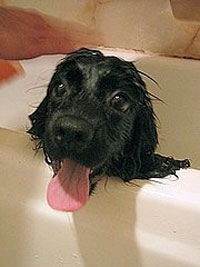 Puppy bathing: This is fun!
If you prefer to use a shower spray for bathing your puppy, ensure you have it facing away from him when you turn on the water; otherwise, you might startle him.
Your aim is to get your puppy used to the feel of warm water and the sound of it splashing around him without feeling anxious or frightened.
If he seems uncomfortable at any point, quickly turn off the taps and wait to see if he settles down before trying again.
If he doesn't settle, pick him out of the bath, wrap him in a fluffy towel, and try another day.
Step 5: Get Him Used To The FEEL of Running Water
Your Cocker Spaniel should by now be happy with the sound of gently running water while he's sitting in the bath.
Now we need to get him used to the feel of the water running onto his coat.
Keep him away from the taps.
Ask him for a paw. When he gives it to you (awww!), place your hand underneath for support and, with the other hand, gently scoop up some water and pour it onto his paw.
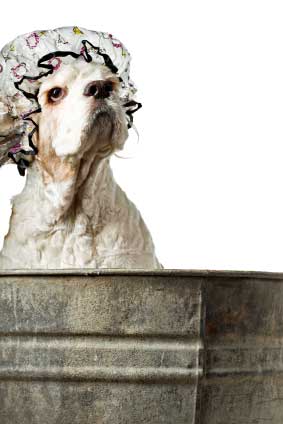 I'm ready for my bath now Mom!
He may try to drink the water or lick his paws, but that's okay; just make sure there are no doggie bath bubbles in it!
If he's okay with this, gently wet the back of his coat using either a spray head or a small plastic beaker.
Let your puppy see where the water's coming from, and let him feel the water running onto his body.
Gently scoop up some water and run your hands over his coat. Take it slowly and gently; don't startle him. You never know; he may take to his puppy bath like a duck to water, in which case you've cracked it!
Step 6: Bathing A Puppy: It's Time For Bubbles!
Remember, the whole point of bathing puppies is to end up with a clean, relaxed and happy pup.
Be prepared to get wet and soapy, if not a little grubby! Now that your puppy is happy in the bath and water, it's time to get him clean.
Rather than repeat myself, you'll find our ultimate guidelines for bathing your dog here.
You'll find lots of helpful advice and information on washing your Cocker Spaniel and a list of items essential to bath time.
The advice also applies to puppies as long as you've followed the advice given above and your puppy is fully relaxed and comfortable with the bathtub.
When you've finished bathing your puppy, don't worry if he just sits there; he may be slightly shell-shocked, especially if this is his first bath time!
Step 7: Use A Soft Fluffy Towel To Dry Your Cocker Spaniel Puppy
For now, you'll be able to dry off your puppy with a soft fluffy towel, but as he gets older and grows feathers, a towel won't be enough to dry him.
If your puppy is already familiar with a hair dryer, and you have used one whilst socialising him, you can finish drying him off with a hair dryer.
If you didn't socialise your puppy with a hair dryer, now is the time to do it.
Points To Note:
Common sense prevails when using a hair dryer on your puppy or dog:
- As always, take it slowly and gently.
- Never use the highest heat setting; use the coolest or relatively warm setting on your hairdryer.
- Please don't hold the hair dryer too close to your puppy, as the heat may burn his delicate skin.
Once he's been bathed and blow-dried, your little furry bundle will smell and look clean. His coat will shine and feel soft and silky to the touch, just like a tiny puppy should!
Your puppy's bath time should be fun; let his first experience be a happy one!
Brushing Your Cocker Spaniel Puppy
Bathing a puppy can make tats and mats worse (if there are any), so it's always best to get into the habit of brushing your puppy before you bathe him to remove any tangles or matting first.
 Freshly brushed and posing for the camera!
Currently, your Cocker Spaniel puppy will be pretty easy to brush.
However, when he's fully grown, his coat will grow longer, and he will develop feathers, attracting dirt, leaves, burrs, twigs and other debris, all of which can cause tangles and matting.
Follow the link if you'd like to read more about brushing an adult dog.
Some Other Pages To Help You Care For Your Puppy
Puppies are like babies; they can't fend for themselves and take a lot of looking after! Here are a few more pages about Cocker Spaniel Puppy Care which you may find helpful.
Want To Know How To Choose A Dog Bed? You're In The Right Place!
You're here because you want to know how to choose a dog bed! These valuable tips will help you choose the right bed for your pet; he'll spend a long time in it
Ear mites in puppies: Here's How to keep your pet's ears healthy!
Ear mites in puppies can cause so much discomfort for your pup. Learn about the symptoms, treatment for ear mites, and prevention to help keep your puppy safe.
Puppy Proofing Your Home; Help To Keep Your Pup Safe
It's almost time to bring your puppy home, but can you be sure your home is puppy proof? Learn how to make your puppy's new home safe and protect him from harm.
Socializing A Puppy
Do you want to give your puppy the best start in life? These tips on socializing a puppy will help him grow into a happy, healthy, confident adult dog.






Photo credits for Bathing A Puppy:
1. Tootles at https://www.istockphoto.com/photo/puppy-ready-for-a-bath-gm95186820-1713327
2. Visitor photo
3. Debbi Smirnoff at https://www.istockphoto.com/photo/bath-time-gm184294400-17030543
Recent Articles


-
Is Your Puppy Teething? How to help ease your new Cocker's pain!
Jul 10, 24 07:07 AM
 Is your cute puppy getting his first set of baby teeth? Find all you need to know about puppy teething to help your Cocker Spaniel through this difficult phase.
 -
What you eating?
Jul 02, 24 05:09 AM
 This is my Chocolate Merle Cocker Spaniel. He's a hyper-energetic boy who's always on the lookout for food!
 -
Want to train your dog to come back to you immediately? Learn how here
Apr 12, 24 12:36 PM
 Teaching your puppy recall is one of the most important things you will ever teach your Cocker. Learn how to train your dog to come back when called.