- Home
- Puppy training
- Crate training a puppy
Crate Training A Puppy: Essential Rules
One of the most important rules of crate training a puppy is to make sure your pup's experiences in and around his crate are positive; it's vital that he doesn't have any negative experiences, otherwise he may never accept his crate.
Follow these basic rules and crate training your puppy will be a breeze!
Basic Rules Of Crate Training A Puppy
Our essential rules of crate training starts off with some simple tips to bear in mind to help you (and your pup) get it right, without any drama.
Let's take a look at them shall we?
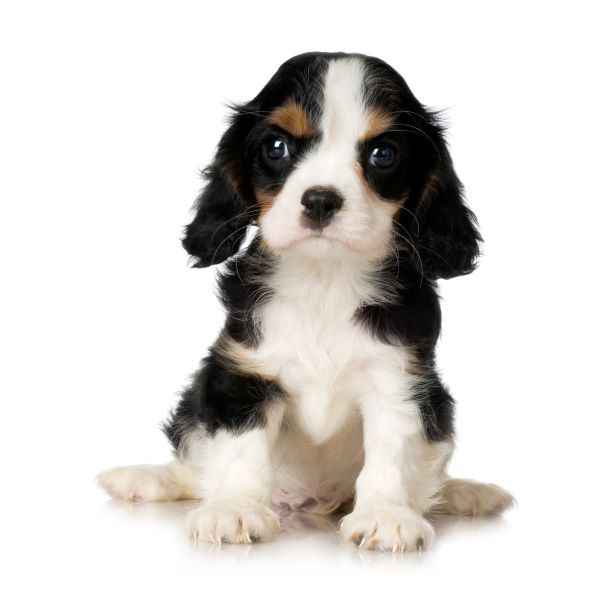
 I love being in my crate!
- Let your puppy discover his crate naturally.
Decide where you're going to put it (see below) and leave it there. He'll soon get used to seeing it and if you throw in a toy or couple of treats he'll probably be curious enough to step inside without any encouragement from you. - One of the most important rules of crate training a puppy is to never force your puppy to go into his crate. If you do, your pup may never grow to like it let alone love it.
- Never
use your puppy's crate as a punishment. If you do, he might associate being
crated with being punished. He'll see it as a negative place and may even come to resent his crate.
- Take your pup to his toilet area before he goes to bed for the night, leaving it as late as you possibly can is best.
- As soon as he wakes each morning pick him up and take him outside again - he'll almost certainly need to pee! (You're trying to help him avoid peeing inside his crate).
- Place your puppy into his crate whenever he falls asleep to help him learn that his cage is for calm, peaceful times.
- Always remove your puppy's collar before leaving him alone in his crate. Accidents can and do sometimes happen!
- Puppies under 10 weeks of age shouldn't be left alone in their crate for any longer than 30 minutes each day, unless of course, they're asleep!
- Never allow children to play in your puppy's crate. It's simply dangerous.
- Encourage children not to bother the puppy when he's in his crate. Your puppy needs to feel that his crate is his own safe haven; a place to get away from it all when things get too much for him.
- Get
into the habit of placing your Cocker Spaniel into his crate for short periods
while you're at home. This will help to prepare him for being left alone for longer and will help avoid separation anxieties.
- Crate training a puppy shouldn't be onerous. It should be fun so keep the tone of your voice light and playful!
Read on for more essential rules of crate training puppies to help your new pet settle into his crate quickly and quietly.
Positive Experiences Only!
Any frightening or negative experiences your puppy has while inside his crate, or during crate training, and you're going to have set-backs.
One of the first rules of crate training a puppy is to make sure his experiences in his crate are all good ones.
No negative experiences please!
You can do this by making your puppy's crate as comfortable as possible in order to entice him to use it.
A couple of soft dog blankets in the base and perhaps one of his favourite toys should do the trick. If you throw in a couple of small treats every now and then for him to discover accidentally, that will help too.
And don't forget a small bowl of water in case he gets thirsty.
If you bought a crate big enough for him when he's fully grown, your pup may (while he's still small) use one end to sleep in and use the other as his toilet. That's why I recommend you section off part of the crate so that he can't do this. You can gradually increase the size of the usable area as he grows.
Now that it's nice and comfy, let's get on with understanding some essential rules of crate training to help you and your puppy get the best out of his crate!
Best Place For Your Puppy's Crate?
The best place to site your puppy's crate is somewhere where he can see what's going on. It needs to be lively, but quiet enough to allow him to rest and sleep without being disturbed.
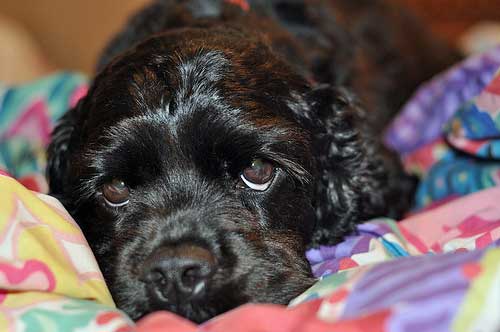
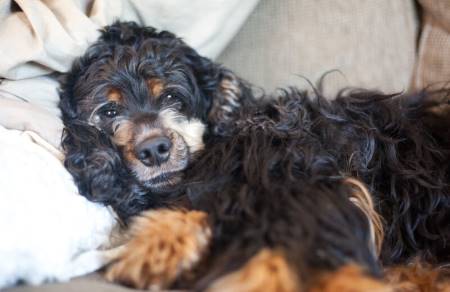 I'm comfy in my dog crate!
It goes without saying that it shouldn't be placed near a draughty window or door.
Apart from the obvious, he won't be comfortable and it will be almost impossible for him to settle down and sleep.
The best place for your puppy's crate is in a corner because it will help to keep him out of any cold drafts, he'll be able to watch what's going on, and it will create a comfy, den-like feel to his crate which will help him to feel more secure.
If you don't have a spare corner to use, the next best thing would be to drape a towel or a bed sheet over the crate, leaving the entrance open.
Locking The Crate Door
At some point you will want to lock your puppy inside his crate while you get on with your day.
One of the most important rules of crate training is not to lock the door on your puppy's crate until he's really comfortable with being inside.
This is really important.
Any negative experiences at this stage will set you back; you will undo any progress made to date and may not be able to move forward as quickly as you might like.
Crate Training A Puppy: Crying
This is probably one of the most important rules of crate training a puppy. If your puppy cries to be let out of his crate, ignore him.
That's right, I said ignore him.
I know it sounds a little cruel, but if you give him attention when he 'demands' it, you'll be teaching him that each time he wants to get out of his crate, all he needs to do is cry!
Your puppy will learn that by using attention-seeking behaviour (his crying) he can manipulate you into doing what he wants...sneaky eh?
He'll most likely cry during the night (for a week or two until he's settled).
It's best if you take him out into the yard as late as possible and before he goes into his crate for the night.
This way, when he does cry at night you can be certain that he's not needing to pee.
If you're certain that your puppy wants to pee, take him straight to his toilet area and stay with him and encourage him to 'go potty'.
Don't fall into the trap of playing with him or making a fuss, otherwise he'll not pee but he'll want to play and enjoy your attention. The aim is to teach him that night-time is for sleeping!
If he doesn't do the business within 10 minutes bring him inside and put him back in his crate and leave him.
So the next time your little puppy cries during the night and you're certain that he's warm and
comfortable, ignore him. I know it's easier said than done, but I promise you he'll
soon drop off to sleep again.
Rules of Crate Training a Puppy: Summary
Follow The Basic Rules of Crate Training
Follow our basic rules of crate training above and your Cocker Spaniel puppy will take to his crate quickly and without fuss.
A crated puppy is a contented puppy!
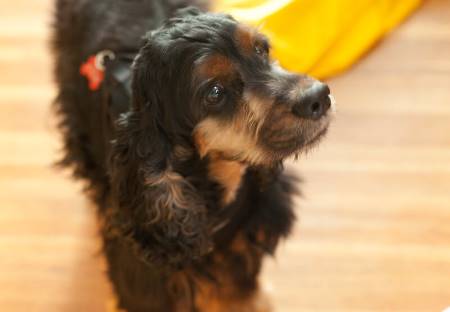 I love my crate, Mum.
Crating Can Help With Potty Training!
As an additional bonus, crating your puppy can be very useful if you're still potty training because dogs (and puppies) try very hard not to pee in their own den.
No Negative Experiences
Make sure your puppy has no negative experiences whilst he's in his crate. Help him to view this space as his own personal den where he can be safe and comfortable.
Give Him A Room With A View!
Make sure his crate is placed where he can watch what's going on, but also where, if he's tired, he can fall asleep quietly without being disturbed.
Go Easy Locking The Crate Door
Locking your puppy in his crate should be done very carefully and gradually, and preferably without him realising that you're doing it, otherwise he may become frightened.
Thus creating a 'negative' experience which is the last thing you want. Follow this link to discover the steps to closing the crate door.
Take Your Time
Above all, crate training a puppy takes time and patience.
Take it slowly, step by step and your puppy will soon be coming in and out of his crate without being asked.
Good luck!
Photo Credits for Rules of Crate Training a Puppy:
1. Juplife at http://www.flickr.com/photos/juplife/5115975778/
2. Neil Conway at https://www.flickr.com/photos/neilconway/5533087173/
3. Neil Conway at https://www.flickr.com/photos/neilconway/5748221179/
Recent Articles


-
Want to train your dog to come back to you immediately? Learn how here
Apr 12, 24 12:36 PM
 Teaching your puppy recall is one of the most important things you will ever teach your Cocker. Learn how to train your dog to come back when called.
 -
Want to know how to train a Cocker Spaniel to drop his ball?
Apr 12, 24 12:25 PM
 Train a Cocker Spaniel to let go of whatever's in his mouth, without hesitation, and you won't regret it. This is an excellent command to teach your puppy!
 -
Puppy obedience training can help keep your new puppy safe!
Apr 12, 24 12:13 PM
 Giving your puppy obedience training, such as sit, stay, wait, come etc., will help you to shape a well-behaved puppy and will also help to keep him safe.