- Home
- Getting A New Puppy
- Essential puppy supplies
Essential Puppy Supplies For Your New Cocker Spaniel
If you're unsure of what your new puppy will need, this essential puppy supplies checklist will ensure you have all you need before your puppy arrives in his new forever home, leaving you to concentrate on more important things like chilling out and enjoying your new Cocker Spaniel puppy when he arrives.
Relax; we've got you covered!
Basic Puppy Supplies For Your New Puppy
At the very least, this list highlights the basic puppy supplies you must have before you bring your puppy home. Anything else will be nice to have but will not be necessary; you can always buy more later.
Essential puppy supplies your new pet will need are:
- A supply of good quality puppy food,
- Food and water bowls, preferably heavy ceramic,
- Register with a vet you feel comfortable with,
- A puppy crate,
- Some comfortable bedding,
- A grooming brush and comb,
- A few select puppy toys,
- A new puppy collar and lead,
- An identification tag,
- A selection of training treats,
- A poop scoop and doggie bags
- A reliable pet urine odour remover
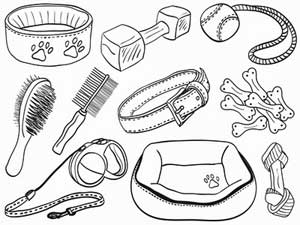 Basic puppy supplies for your new pet
Essential Puppy Supplies: Quality Puppy Food
You must have at least a small bag of good quality puppy food in-store; it's the most important thing your puppy will need to help him grow strong and healthy and get off to a good start in life!
Your breeder will likely give you a diet sheet and a small supply of carefully chosen puppy food with which your pup is already familiar.
 Feed your puppy good quality kibble
I strongly recommend that you continue feeding him with this particular puppy food so that you don't interrupt his development or upset his little tummy.
However, if you decide to change brands later, check the new brand's ingredients label to ensure your puppy is still getting the exact balance of nutrients his little body needs.
Don't change foods overnight; otherwise, you risk upsetting your puppy's delicate digestion. If you change your puppy's food, feed a mixture of new and old, and gradually replace the old puppy food with the new.
Do it this way, and your Cocker puppy won't notice any change in his diet. It will allow his little tummy to get used to his new food without getting upset.
Essential Puppy Supplies: Food And Water Bowls
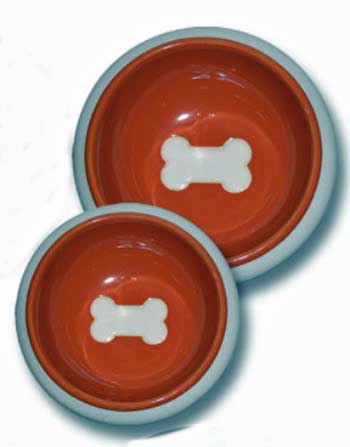 Ideal food and water bowls for your new puppy
On our essential puppy supplies checklist, you'll find a food bowl and a specially shaped-bowl for your puppy's drinking water.
The sides of the water bowl should slope inwards so that the pup's ears don't dangle in the water when he drinks, but be aware it doesn't always work as it should. Max's ears often dangle inside his water bowl; he walks away, dribbling water from his ears all over the kitchen!
Ceramic bowls are better than light plastic ones as they don't tip over as easily.
Essential Puppy Supplies: Buy Him A Crate
Buying a crate for a young puppy is a must!
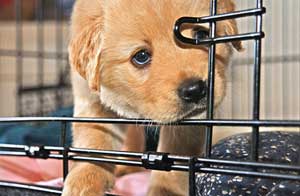 Hello Mum. Can I come out now?
Your puppy will soon see his crate as his den, where he can be safe and comfortable away from the madding crowd. He will often use it as a haven away from our human world when things get too much, especially if loud, excited children are around.
Your breeder will almost certainly have kept their puppies in a crate, so your little one should feel relaxed about sleeping in a crate in his new home.
Teaching your puppy to use a crate will be necessary if he's to settle in quickly. If you have to go out for a couple of hours or do some housework, you can place him inside his crate, safe in the knowledge that your new puppy won't come to any harm.
Essential Puppy Supplies: A Comfy Bed!
You might want to put off buying an expensive dog bed for your Cocker until you've managed to control his chewing; otherwise, you may come home one day to find that very expensive bed in shreds!
However, when your puppy has passed the chewing stage and you're ready to buy his 'Big Boy' bed, here's some helpful info on choosing your dog's bed.
I'd say vet bedding is the most useful of all the puppy supplies on this page. It's inexpensive and ideal for a young puppy!
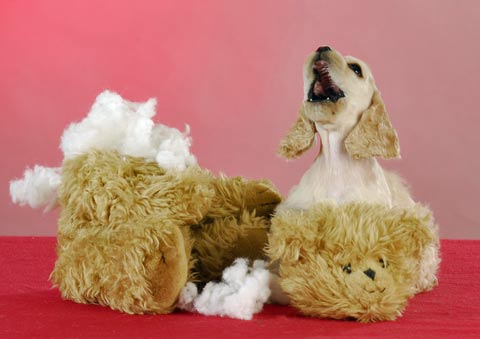 Puppies chew so don't buy an expensive bed just yet!
Puppies chew, so don't buy an expensive bed just yet!
It looks like a square of sheepskin, but it's a machine-washable thick pile made from strong polyester fibres, which make it harder to chew.
It's also non-toxic, non-allergenic, and resistant to bacteria.
It also has a latex-coated open-weave backing which lets moisture seep through, keeping your puppy dry. You can pick it up from any pet shop, or your vet may stock it.
It can be expensive (not as expensive as a designer dog bed!), but its strength and durability mean it can last a long time.
In addition to using it in the home, it's also used in vet clinics to provide warmth and comfort for sick animals or those recovering from surgery.
You can cut it to size to line your puppy's crate. I bought two pieces, one for use in Max's crate while the other was in the wash. Thirteen years later, they're still going strong!
When your puppy is trained only to chew his chew toys, it will be the ideal time to buy him his first 'big boy' dog bed.
Essential Puppy Supplies: Grooming Tools
Your puppy's coat won't need the same grooming as an adult Cocker Spaniel; however, I recommend you begin brushing him and prepare him for grooming as early as possible.
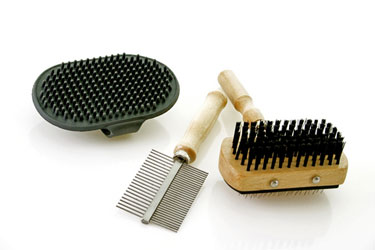 Your puppy will need a couple of brushes
Gentle brushing will help your Cocker pup get used to the feel of a brush and a comb, of being handled frequently, and as a bonus, it will also help to keep his coat healthy and shining!
Regular grooming is essential for adult Cocker Spaniels because their feathers attract burrs and twigs.
Their coats need brushing often. At the very least, twice weekly, but if you have time, brush your puppy when you return home from your walk. I recommend you check for (and remove) any vegetation stuck in his fur.
All you'll need for the moment is a soft puppy brush and perhaps a tiny metal comb, but as your puppy's coat and feathers develop, you'll need a more extensive selection of grooming accessories.
Essential Puppy Supplies: Collar And Lead
Once your puppy has settled into his new home, you can introduce him to his puppy collar and a soft, pliable lead.
 You'll need a dog lead for your new puppy
Put a collar on your puppy as soon as you get him home, just in case he ever escapes (heaven forbid!). Let him wear it during the day, but not when he's in his crate, and take it off at night.
It's also a good idea to introduce your puppy to the feeling of being on a lead at such a young age.
If you take it gently and slowly, he'll soon get used to his collar and leash, and in no time at all, he'll let you put them on and take them off without any fuss.
Learn more about leash training your puppy, and enjoy long gentle walks with your little boy sooner than you think!
Essential Puppy Supplies: Identification Tag
An identification tag is among the most important of all the essential puppy supplies listed.
Depending on where you live, it's a legal requirement for your puppy to wear an identity tag on his collar. It makes sense too. I recommend engraving it with your name, address and zip or postcode.
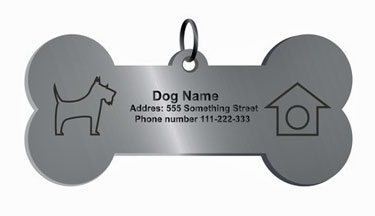 A dog tag is very important if your puppy gets lost!
It seems strange that your telephone number is not required by UK law, but I recommend including it to make it easier for someone to contact you if your pet is lost.
Whether you add your puppy's name is your choice, but I wouldn't recommend it, as it can make life easier for dog thieves.
Essential Puppy Supplies: Puppy Toys
Your puppy will need some toys to play with and a couple of chew toys to help him with his teething.
Every puppy needs a soft toy for comfort, just like a baby uses a teddy bear, so remember to buy him something to snuggle into.
I also recommend a toy or two that will stimulate his mind. For example, with a toy that drops small treats out of a ball, the trick is to learn how to roll the ball to get at the treat! That will get his mind working!
Ensure you buy the right size toys for him and check that they're suitable and safe for young puppies.
While Max was a puppy, I always preferred to stuff the Kongs with his kibble to ensure he had all the necessary nutrients a puppy would need.
Nowadays, I have several Kongs, and I stuff them with either rice and lamb or paste, rice and a little peanut butter (the possibilities are endless!), and Max loves them.
These also slow down his eating, which is good for his digestion and keeps him occupied (read quiet!) for ages.
You must remember to reduce the amount you feed your puppy if you give him stuffed Kongs; you don't want your puppy to become overweight!
Tip: When buying from stores that offer discount pet supplies, check the product's quality and scrutinize it. The last thing you want to do is buy your puppy substandard toys or chews.
Puppy Supplies: Choosing A Friendly Vet
Your puppy won't need to visit the vet too often (other than for vaccinations and regular health checks), but you should take some time to choose a vet you feel comfortable with.
Do this well before your puppy's arrival so that you can give the vet at least one week's notice of an appointment.
Most good breeders recommend that you arrange to have your puppy examined by your vet (usually within 24 hours of bringing him home) to check his health.
In the unlikely event that something is wrong with your puppy, you may be entitled to a full refund or to choose another pup, depending on your contract with the breeder.
Before deciding which veterinary practice you will use, phone a few surgeries and ask to speak to one of their vets; if they're busy, they may ask you to call back later when the surgery is quiet when they have more time to talk, but that's fine.
Don't bother with those who make you feel intimidated or stupid.
Choose a vet you feel comfortable speaking to, who will listen to you, and who will take the time to explain to you what (s)he's doing and why.
Most importantly, your vet should take a genuine interest in your puppy and handle him gently and kindly.
Have Your Puppy Microchipped
I strongly recommend having your puppy microchipped.
It's so tiny (the size of a grain of rice) that your vet can inject it into your puppy. Should your puppy ever wander off, a shelter, dog warden, vet (and sometimes the police) can scan your puppy for a registered microchip. Once they have the code, they can obtain your contact details and get in touch.
It's worth the extra expense and effort.
Extras: Puppy Supplies To Have On Hand
You might also like to have a packet of training treats handy for when you begin his training - it's never too early to begin his obedience training - the sooner, the better!
And, of course, you'll need a ready supply of poop bags, a poop scoop, and a good cleaning agent to get rid of puppy urine smells; one that doesn't just mask them.
Nice To Have But Not Essential Just Yet!
Puppy supplies you may not need right now but you will need later are:
- A nice plush dog bed for when he's past that chewing stage.
- A food scoop and a suitable solid container will be handy, especially if the container is puppy-proof. Don't underestimate your Cocker; between his determination to get at food and his sharp little puppy teeth, he'll soon make mince meat out of a plastic or cardboard kibble packet!
- Additional dental products, such as a puppy toothbrush (I recommend you get him used to the idea now) and a couple of rawhide or chew toys, are perfect for a teething puppy!
- Extra toys to play with so that he doesn't become bored.
- Flea and tick treatment, but check with your vet before you buy them. The treatments must suit your puppy and his age because some medications are unsuitable for a puppy under six months.
- You might want to consider a dog carrier so that you can transport him safely to and from the vet, and you might also want to provide him with an outdoor dog kennel to shelter him from the elements if he's left outdoors for longer than an hour or so.
- Lastly, if you plan on grooming your Cocker Spaniel rather than taking him to a professional groomer, you'll need to buy more grooming tools to help keep your pet in tip-top condition.
Photo credits for Essential Puppy Supplies:
1. kytalpa at http://www.fotolia.com/id/41363594 (sketch dog supplies)
2. Author's own photo of puppy kibble
3. Dog Bowls - Unknown
4. Willeecole at http://www.dreamstime.com/royalty-free-stock-image-bad-puppy-image17910556 (puppy chewing toys)
5. Birgit Reitz-hofmann at http://www.dreamstime.com/stock-photography-dog-brushing-tools-image5794132 (grooming brushes)
6. Tombaky - Fotolia.com (dog tag)
7. Chris Lester at Flickr.com - 71506456_d3e9ca0324_c Chris Lester-Flickr (puppy peeking out of crate)
8. Andrew Burgess at http://www.dreamstime.com/royalty-free-stock-photos-red-nylon-dog-lead-leash-paw-print-image26666038
Recent Articles


-
Want to train your dog to come back to you immediately? Learn how here
Apr 12, 24 12:36 PM
 Teaching your puppy recall is one of the most important things you will ever teach your Cocker. Learn how to train your dog to come back when called.
 -
Want to know how to train a Cocker Spaniel to drop his ball?
Apr 12, 24 12:25 PM
 Train a Cocker Spaniel to let go of whatever's in his mouth, without hesitation, and you won't regret it. This is an excellent command to teach your puppy!
 -
Puppy obedience training can help keep your new puppy safe!
Apr 12, 24 12:13 PM
 Giving your puppy obedience training, such as sit, stay, wait, come etc., will help you to shape a well-behaved puppy and will also help to keep him safe.