- Home
- Cocker Spaniel Health Issues
- Household Dog Poisons
Dog Poisons Lurking In Your Home
A lethal cocktail of dog poisons, innocently disguised as normal household cleaners are sitting in your kitchen cupboards right this very minute! Ensure you understand which are harmful to your pet.
Keep your Cocker Spaniel safe and lock all cleaning products away!
Cleaning Products Contain Dog Poisons
We use a wide variety of chemicals to clean our homes and keep our gardens in tip top condition.
Many of these products contain toxins that could prove fatal to our pets (and of course our children) so it's vital that we keep them locked up or at least out of reach.
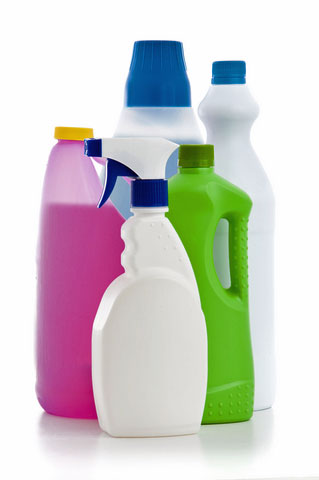 Beware - household chemicals are dog poisons
Household cleaners such as bathroom and kitchen sprays, drain
de-blockers, bleach, oven cleaner, and general detergents, contain
corrosives and caustics which, if swallowed, can burn your pet's mouth,
throat and stomach.
Just like children, Cocker Spaniels are curious and many like to chew on just about anything that they can get their jaws on, which is why it's sensible to keep household products such as these locked away from our pets at all times.
Dog Poisons In The Form Of Family's Medicines
Medicines are often flavoured to make them taste better.
Not only that, they're usually very colourful too which can mean that they're more likely to be attractive to both family pets and our children.
It's important to keep all medicines prescribed for human use out of reach of your Cocker Spaniel (as well as our kids).
We mustn't forget pet medicines either.
 Medicines could poison your dog if he ate them
For example, organophosphates and carbonates (all potential dog poisons) are used in preparations for de-fleaing and worming your pet.
These are absorbed through the skin and, if applied incorrectly or too often, (accidentally, of course) it can result in an overdose and affect your pet 's nervous system.
Keep pet medicines out of reach of nosy Spaniels and always follow the application instructions on the manufacturers' packaging. Be safe!
Potential Dog Poisons Lurking In The Garage!
The garage may store many substances which could prove fatal to your pet.
Petroleum Products
Petroleum products can be poisonous to dogs and can cause burning of the mouth, throat, and stomach and can be even more harmful to puppies.
If
your Spaniel is sick after ingesting petroleum products, it can enter his
air ways, resulting in aspiration pneumonia and lung damage.
Do not induce vomiting if your pet accidentally swallows petroleum products unless specifically instructed to do so by your vet.
If your Cocker manages to eat a petroleum based product, his symptoms may include difficulty in breathing, panting, pawing at the mouth, tremors, and convulsions.
In serious cases, particularly where treatment is not administered quickly, your Spaniel may develop respiratory failure with fatal consequences.
It doesn't bear thinking about, does it?
Anti-Freeze Is A Killer!
The biggest killer in the garage is antifreeze
(Ethylene Glycol).
It has a sweet smell and a taste that dogs love, making it one of the most sinister dog poisons I know. Even a small amount (half a teaspoon per pound dog weight) can have fatal consequences!
Antifreeze poisoning can take effect very quickly and can cause vomiting, staggering, weakness, coma and death within 12 - 36 hours.
You have been warned - please lock it away!
Dog Poisons In Your Garden And Lawn
Don't forget when treating your lawn or garden with fertilisers and weed killers to check on the packaging, as many recommend that you keep your pet away from the treated area until it dries completely.
Check Your Greenhouse And The Garden Shed!
Rat poisons, slug pellets, ant killer, insecticides, and weed killers - many of us may have some or all of these products sitting on a shelf somewhere in our greenhouse or our garden shed.
Most of the chemicals in these products can be lethal for your pet if he manages to get hold of them.
Arsenic
Arsenic is usually found in slug killer, weed killer and insecticides. If eaten by your Cocker, they can cause death quite quickly.
The first signs of arsenic poisoning are thirst, drooling, vomiting, staggering, abdominal pain, and diarrhoea.
If you suspect your Spaniel is suffering from arsenic poisoning, (check his breath, it may smell of garlic) phone the vet immediately and inform him of the symptoms.
Lead
Sometimes lead can be found in insecticides and other garden products, and also in paints.
However, not many paints contain lead today, so there is less risk of poisoning for puppies when chewing painted surfaces...as puppies like to do!
Symptoms of lead poisoning may include loss of appetite, abdominal pain, vomiting, chomping of the jaws, and constipation quickly followed by diarrhoea.
The nervous system may also be affected, causing seizures, muscle spasms, excitation, paddling of the legs, lack of coordination, disorientation and circling.
I'd like to point out that the chemicals and toxins mentioned here do not represent a complete list of toxins to be found in a household environment. There are many, many more that could harm your pet.
Information given here is intended for guidance only.
If your Cocker accidentally eats any dog poisons, consult your vet without delay - guidance is given here on what to do in an emergency.
Photo Credits: Dog Poisons
1. Mohamed Osama - https://www.dreamstime.com/royalty-free-stock-images-house-cleaning-chemicals-image23463769
2. Illeana Olaru - https://www.dreamstime.com/royalty-free-stock-photography-medicines-image13045577
Recent Articles


-
Want to train your dog to come back to you immediately? Learn how here
Apr 12, 24 12:36 PM
 Teaching your puppy recall is one of the most important things you will ever teach your Cocker. Learn how to train your dog to come back when called.
 -
Want to know how to train a Cocker Spaniel to drop his ball?
Apr 12, 24 12:25 PM
 Train a Cocker Spaniel to let go of whatever's in his mouth, without hesitation, and you won't regret it. This is an excellent command to teach your puppy!
 -
Puppy obedience training can help keep your new puppy safe!
Apr 12, 24 12:13 PM
 Giving your puppy obedience training, such as sit, stay, wait, come etc., will help you to shape a well-behaved puppy and will also help to keep him safe.