- Home
- Best quality dog food
- Dog food ingredients
Dog Food Ingredients and Pet Food Labels
Choosing the best dog food ingredients for your Cocker will help him to develop strong teeth and bones, a glossy coat, unblemished skin, and clear shining eyes. Understand what makes a nutritional diet and learn how to read pet food labels to ensure your pet's diet is healthy.
What Goes Into Our Pet's Food?
Some of us may prefer to feed our dogs human-grade food such as natural or organic dog food, prepared lovingly in our own kitchens.
 Feed your dog the best quality ingredients you can afford
 Others prefer to buy it ready-made from reputable pet stores, supermarkets or our local vet.
Whether we choose to prepare our Spaniel's meals from scratch or buy commercially prepared dog food, do we really understand what our pets should eat in order to get the right amount of nutrition their bodies need?
And do we know how to make sure that the food we feed our dog is nutritious? What do dog food ingredients labels really tell us?
Let's see if we can answer these two questions, shall we?
A typical Cocker Spaniel's diet should consist of the following; proteins, carbohydrates, fats, vitamins and minerals and you can find out which foods provide this nutrition and how to read dog food ingredients labels below.
Nutrition and Reading Dog Food Ingredients Labels
Proteins To Help Build Him Up!
Your Cocker Spaniel will need protein in his diet to help him grow strong.
Fish and
high quality meats such as lamb, chicken, turkey, beef, pork, are all
excellent sources of protein, although beef is less digestible than
other proteins and is sometimes responsible for causing allergies.
On checking the manufacturer's dog food ingredients label, if the protein is listed as bone meal or poultry by-products, don't be fooled, these are not high quality proteins.
Lamb in particular is a good source of protein and is rich in calcium and zinc. It's often used in hypo-allergenic pet food.
Eggs are also an excellent source of protein, they're easily digestible and will provide extra vitamins and minerals for your Spaniel.
When Max was recovering from an operation our vet suggested I feed him a light meal of boiled rice mixed with a scrambled egg for a day or two.
The food wasn't in his bowl for long, he really enjoyed it and I'm sure
if he could speak to me, he'd confirm this!
Carbohydrates To Give Him Lots Of Energy!
Fresh fruit and vegetables such as blueberries, apples, tomatoes, carrots, potatoes, parsnips, spinach, broccoli, and whole grains, are excellent foods that slowly release carbohydrates during the day, giving your Cocker Spaniel all the energy he needs.
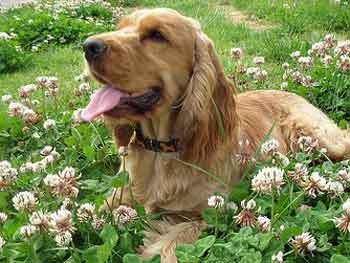
 Do I look Hungry To You?
Whole grains such as rice, barley, and oatmeal are excellent sources of carbohydrate for your pet. They're sometimes listed under 'cereals' on dog food ingredients labelling.
Take note that if the 'cereal' has not been named, ie rice or barley, it could be disguising the fact that a mixture of cheap fillers or bulking agents (ingredients used make your pet feel full) such as corn have been used. These 'fillers' are often difficult for dogs to digest.
Wheat is also a carbohydrate regularly used in pet foods; however it's no-longer included in many hypoallergenic preparations as it's often associated with causing food allergies.
Personally, I prefer
to give our Cocker Spaniel rice or oatmeal. Rice is easily digested and
very often used in hypoallergenic foods. It's low in fat too!
If your dog is allergic to rice, potato may be used in it's place.
On checking dog food ingredients listed on the manufacturers' packaging, if you
see any sign of processed carbohydrates such as powdered potato or
refined flours, avoid it if you can - the less your pet's food is processed, the better.
Vegetables are Excellent Dog Food Ingredients!
We all know that veggies are very good for humans, but they're also good for our Spaniels too and should be a part of his diet!
As I said earlier, vegetables are a good source of carbohydrates but
some also contain protein such as lentils, garden peas, or spinach. They're also an excellent source of vitamins and minerals, for example,
carrots contain beta-carotene, which is essential for the production of
Vitamin A and healthy eyesight!
My dog loves to eat raw red pepper, he's not keen on cucumber and will only eat carrots if they've been cooked, but he'll eat almost any other vegetable.
Dog Food Ingredients: Fats And Oils
Only choose natural foods that contain fats and oils that are specifically named; fish oils (the fish should be named, for example, salmon, cod) animal fats (the animal should be listed, for example, lamb, beef, chicken) and vegetable oils such as olive or sunflower oil.
These are all excellent sources of fats and are essential to your pet's well-being.
Manufacturers' Dog Food Ingredients: Labeling
Your Cocker Spaniel's healthy diet ought to be made up of fresh human-grade food without artificial preservatives or colours, but how can you be sure that what you're buying off the shelf is the equivalent of a nutritious doggie diet?
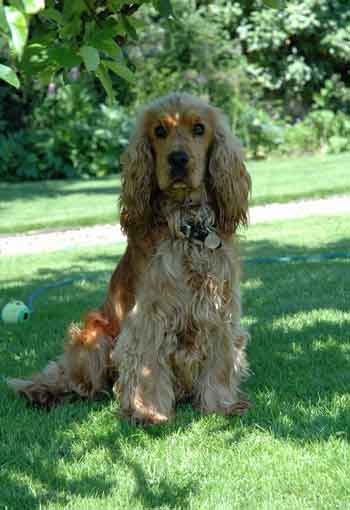
 My Mum feeds me a very healthy diet!
You need to be able to read and understand pet food labels, but sometimes they can be a little misleading.
All dog food ingredients are usually listed on the manufacturers' packaging. If you've never checked this list before why not take a look right now? Go on, I'll wait for you.
Most manufacturers list the percentage of each food included, for example, 20% lamb. However, if they don't show the percentages, ingredients are normally listed in order of the highest quantity of content.
For example, if the food contains mostly rice, followed by beef, rice would be placed before beef on the pet food label.
Avoid artificial preservatives such as BHA (butylated hydroxy anisole) or BHT (butylated hydroxytoluene). These are added to foods to prevent fats from spoiling. Only natural preservatives, such as vitamin E, are acceptable in natural dog foods. (Vitamin E does a similar job to BHA/BHT).
Rosemary is also a natural preservative and it tastes nice too!
Similarly, it's best to have natural colours; artificial colours are not acceptable, and let's face it, your Cocker doesn't care what colour his food is!
You may also see fibre listed. Our pets need fibre to help their digestive systems work properly and if they don't eat enough it could lead to digestive and 'toilet' problems.
On the other hand, too much fibre could result in their body being unable to extract enough nutrition from their food.
The dog food ingredients listed on the packaging will probably give more information about what else the food contains, for example, vitamins and minerals, zinc or ash.
Dog Food Ingredients: Summary
Before deciding which diet is best for your pet I strongly recommend that you speak to your vet who will be able to advise you which nutrients your Spaniel needs and in what quantities.
Just to give you an idea, I generally try to keep proteins to between 20 and 25% of Max's diet, with 50% vegetables and 25% rice. I do vary this over several days depending on what's available, but generally, over the whole week it averages out to the above.
He may even have a list of acceptable ingredients (with recommended percentages) and if you plan to make your pet's dinner from scratch, he may even have a few good dog food recipes too.
If your vet feels your dog needs supplements he may suggest additional vitamins and minerals, and if your Cocker Spaniel has specific health problems he may even recommend a prescription dog food diet to help bring your pet back to full health.
Always compare the manufacturer's recommendations with your vet's and if you're in any doubt about any of the ingredients give your vet a quick call - I'm sure he'll be happy to help.
Photo Credits: Dog Food Ingredients
1. Ronnie Meijer at Flickr.com
2. Oze Froze at Flickr.com
3. Jeremiah Roth at Flickr.com - https://www.flickr.com/photos/rothwerx/2648863096
Recent Articles


-
Want to train your dog to come back to you immediately? Learn how here
Apr 12, 24 12:36 PM
 Teaching your puppy recall is one of the most important things you will ever teach your Cocker. Learn how to train your dog to come back when called.
 -
Want to know how to train a Cocker Spaniel to drop his ball?
Apr 12, 24 12:25 PM
 Train a Cocker Spaniel to let go of whatever's in his mouth, without hesitation, and you won't regret it. This is an excellent command to teach your puppy!
 -
Puppy obedience training can help keep your new puppy safe!
Apr 12, 24 12:13 PM
 Giving your puppy obedience training, such as sit, stay, wait, come etc., will help you to shape a well-behaved puppy and will also help to keep him safe.