- Home
- Cocker Spaniel Health Issues
- Dog food allergies
Dog Food Allergies
Dog food allergies can cause many unpleasant symptoms for your pet. They can be difficult to accurately diagnose, but once you know what's causing the problem, you can then go on to treat it.
Learn about causes, symptoms and how best to treat a food allergy and help you nurse your Cocker back to full health again!
Food Allergies in Dogs
A dog food allergy is triggered when the body's immune system mistakenly believes that a particular ingredient in your dog's diet is dangerous to his health.
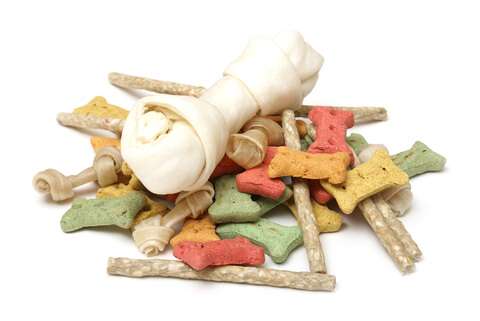 Beware - some treats can cause dog food allergies!
Your Cocker Spaniel may develop an allergic reaction to his food (or treats) at any time during his life, but if it's going to happen, it's more likely to happen when he's around 2 years or over.
And an allergy isn't necessarily triggered by new foods; your dog may suddenly becomes allergic to something he's eaten quite regularly in the past.
Dog food allergies are often difficult to identify because the symptoms can be mistaken for a number of other problems, including; flea bite allergies, intestinal parasites, mange, and yeast or bacterial infections.
Before I go on to list the symptoms of dog food allergies, I'd like to mention food intolerance which is very often mistaken for an allergy.
Is It An Allergy Or An Intolerance?
Food intolerance is not usually as severe as a dog food allergy, but it can often be mistaken for one.
An intolerance arises when your Cocker Spaniel can't tolerate a particular food. The reaction is fairly immediate and plays havoc with his digestive system.
Whereas an allergy often takes time to show itself.
Because an intolerance is a digestive problem it can cause severe vomiting and diarrhoea, but it doesn't normally trigger any immediate skin reaction.
If your pooch is unable to process certain foods, it is possible that over time it could cause a deficiency of necessary vitamins and minerals which in turn could lead to skin problems such as itchy and flaking skin, a dull coat and patches of hair loss.
If your Cocker has an intolerance to certain foods, it's important to make sure that his diet is well-balanced and nutritious to help compensate for the foods he cannot eat. Your vet or a canine nutritionist will be able to help
you with this.
Symptoms Of Dog Food Allergies
Diagnosing the cause of your Cocker's allergy may not be so straightforward as there may be no specific symptom that would directly point to an allergy.
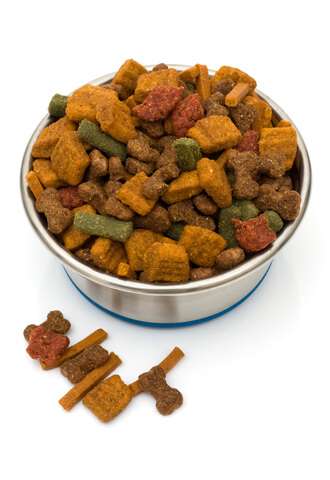 Colourful bowl of dog kibble
Because of this, diagnosis involves trialling exclusion diets until the allergic reactions stop. Only then will you be able to identify which particular food was causing the problem.
To make matters even worse, the symptoms of dog food allergies may come and go. For example, you may see a distinct improvement in your dog's skin, only to discover that he's developed another allergic reaction, such as an ear infection.
Symptoms of food allergies (in no order of importance) include:
- Dry, flaky, itchy skin;
- Itchy paws;
- Excessive hair loss and occasional bald patches in the dog's coat;
- Skin rashes and hives;
- Ear infections and inflammation (in particular, yeast or bacterial infections);
- Constant scratching or licking;
- Skin infections, usually caused by constantly scratching;
- Hot spots;
- Increased bowel movements;
- Gastrointestinal problems such as diarrhoea, vomiting, and gas.
- Weight loss.
Itching is the most common symptom of dog food allergies.
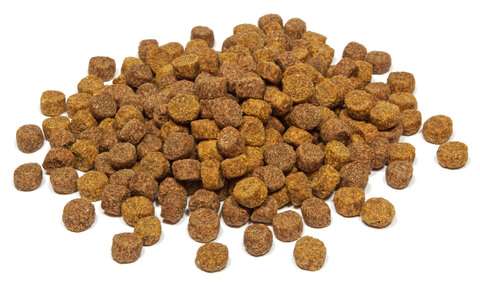 Dog food kibble
Itching can occur on your Cocker's muzzle, paws, forelegs, ears, armpits
and bottom, in fact, pretty much everywhere!
To confuse matters, itching is also associated with many other canine health problems, which is why diagnosing an allergy can be quite difficult.
If your Cocker often suffers from ear infections it may be a sign that he has an allergy to something in his regular diet. Don't waste
any time, take him to see his vet who will be able to offer a correct
diagnosis and swift treatment.
Foods Which May Cause Dog Food Allergies
Common foods said to trigger an allergic reaction in dogs are beef, wheat and dairy, but can also include the following:
- Chicken
- Pork
- Lamb
- Rabbit
- Fish
- Eggs
- Sugar
- Artificial colors
- Corn
- Soya
Unfortunately for us, most commercial dog foods contain some or all of the above ingredients!
Treating Dog Food Allergies
The simple answer to treating an allergy or an intolerance is to provide your Cocker Spaniel with a diet that is totally free of the foods that are causing him problems.
With an intolerance the reaction is fairly immediate, making it easy to identify the offending food and banish it from your pet's diet.
However, with canine food allergies, reactions may not be so immediate, and symptoms can vary, often making the cause of the allergy more difficult to identify.
Dog Treats Can Cause Allergies!
An allergy can sometimes be caused by training treats or other similar dog treats, so I recommend that before you begin any exclusion trials, you stop all dog treats for a week or two to see if that has any effect.
If the allergy remains, or there are no obvious changes then there are other options open to you.
The most recommended method of testing for an allergy is a food exclusion trial and there are several ways this testing can be carried out.
Testing For Dog Food Allergies: Options
Option 1:
As lamb doesn't normally cause allergic reactions in dogs, (although it can) it may be a good idea to begin with moving your Cocker onto a diet of lamb and rice.
Your vet will recommend that you remove all other foods from his diet during a 12-week exclusion trial. Don't forget to stop the treats. Make sure family and friends are also aware of this, and don't feed him any scraps from the dinner table!
Putting your beloved Cocker on a diet of only lamb and rice may sound harsh but don't give in. Ultimately, it's for his own good.
Make sure that if you throw food out for the birds, your Spaniel can't get at it. Max once ate almost an entire walnut cake that had been thrown onto the grass for the blue-tits! (Okay, so baking isn't one of my strong points!) Needless to say, Max wasn't fed that night!
Monitor him closely during the exclusion trial. Symptoms should begin to ease as all other foods are removed from his diet.
If symptoms remain, try him on a diet of rabbit or salmon and rice instead and begin the trial again.
If the symptoms do begin to ease, and there's no allergic reaction for at least 2-3 weeks, you can try adding another food to his diet, eggs perhaps. Continue to monitor him as before for another 2-3 weeks. If there's still no reaction, it's unlikely he's allergic to eggs and it's probably safe to begin adding another food to his diet....and so the process repeats itself.
If, however, the allergy symptoms return after re-introducing a particular food (we'll stick with eggs as an example), it probably means that your Cocker Spaniel is allergic to eggs.
Remove eggs from his diet and you'll more than likely remove the allergy!
Option 2:
An alternative method (although rather tedious and time-consuming) is where one food at a time is removed from your Cocker's diet and then reintroduced after 12 weeks.
During those 12 weeks, symptoms are monitored to see if there are any significant changes.
For example, if you remove beef from your pet's diet and his symptoms improve, that could indicate that he's allergic to beef.
If the symptoms reappear when you reintroduce beef into his diet, that's proof positive that he's allergic to beef.
As your Spaniel may be allergic to more than one type of food, this method may not be as effective as Option 1 above and could take many months to complete!
Option 3:
Starting your pet onto a diet of commercially available hypo-allergenic food may be the easiest option.
Hypoallergenic dog food is carefully prepared with foods such as lamb, salmon, or rabbit, which are less likely to cause dog food allergies.
They
are also usually gluten, wheat and dairy free; however, it's best to
check the label before you buy. It should clearly state that it's hypo-allergenic.
Option 4:
Another option is to prepare your Cocker's dinner yourself and perhaps feed him a raw food diet.
This would give you the reassurance that your dog was eating nothing but healthy, nutritious meals and you'd know exactly what was going into his food.
If you decide to feed your pet a raw food diet,
it is really important that you consult your vet or a canine
nutritionist to make sure your pet's diet is well-balanced and
contains the essential vitamins and minerals to keep him healthy.
Before You Try An Exclusion Diet
Before you trial an exclusion diet, you need to be certain that the symptoms shown are actually caused by an allergy and that your dog isn't suffering from an underlying medical illness.
If you think your dog has an allergy have a chat with your vet first to eliminate all other potential health problems before treating him for dog food allergies.
If the vet confirms that your Cocker does have a food allergy he may
want to recommend a specific diet, perhaps hypoallergenic, a
prescription diet, or even holistic dog food, together with vitamin supplements to use during the trial.
You Might Also Like...
In my opinion, the saying, 'You are what you eat' is quite true. Feed your dog with good healthy food and see the difference it can make to his health and appearance!
 "Pass the salt please"
Photo Credit: Dog Food Allergies
1. Matthew Benoit - https://www.dreamstime.com/stock-image-dog-treats-image14842011
2. KarenR - https://www.dreamstime.com/royalty-free-stock-photo-bowl-dog-food-image15720805
3. Ispace - https://www.dreamstime.com/stock-images-dog-food-image18690034
Recent Articles


-
Want to train your dog to come back to you immediately? Learn how here
Apr 12, 24 12:36 PM
 Teaching your puppy recall is one of the most important things you will ever teach your Cocker. Learn how to train your dog to come back when called.
 -
Want to know how to train a Cocker Spaniel to drop his ball?
Apr 12, 24 12:25 PM
 Train a Cocker Spaniel to let go of whatever's in his mouth, without hesitation, and you won't regret it. This is an excellent command to teach your puppy!
 -
Puppy obedience training can help keep your new puppy safe!
Apr 12, 24 12:13 PM
 Giving your puppy obedience training, such as sit, stay, wait, come etc., will help you to shape a well-behaved puppy and will also help to keep him safe.