- Home
- Cocker Spaniel Health Issues
- How to prevent dog bloat
Dog Bloat: Causes, Symptoms and Treatment
Dog
bloat is a very serious condition of the stomach and can be fatal if
not treated immediately. Read on to understand the causes, symptoms and
treatment because at some point in the future, it could save your Cocker Spaniel's life!
IMPORTANT: If you think your pet may have bloat, stop reading and take him to his vet right now. This condition is a medical emergency and the quicker you get him to his vet, the better are his chances of survival. Please don't delay, act now!
What Is Canine Bloat?
Bloat in dogs is a condition where the stomach becomes swollen, distended and very hard, usually as a result of abnormal volumes of gas, food or fluid.
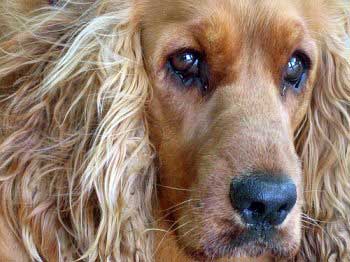 My Tummy Hurts!
It's more than just having a full tummy.
As the stomach swells, twisting can sometimes develop between the oesophagus and the upper intestine. This is known as volvulus, gastric torsion or twisted stomach.
The dangerous combination of a twisted stomach and bloat is known as Gastric Dilatation and Volvulus (GDV) and is often simply referred to as bloat. The twisting causes air, food and liquid to become trapped in the stomach; nothing can move up or down.
As the stomach swells it puts pressure on other vital organs and restricts the blood supply until the organs are unable to function properly because of the loss of oxygen.
Gas continues to build up and without immediate treatment from the vet, dog bloat could prove fatal to your Cocker Spaniel.
What Are The Symptoms Of Dog Bloat?
Typical symptoms may include a tight, extended stomach, inability to vomit or belch, excess drooling, and general discomfort in the tummy area, but there may be additional visible signs such as:
- Anxiety. Your Cocker may seem anxious, restless, and unable to settle comfortably, for example:
One minute he'll want to go outside and the next he'll want to be back in again. He may lie down only to get back up again a minute later to go and lie somewhere else, or he may try to hide.
Pacing is a classic sign of distress and he probably won't want to be bothered by you either ;
- Your dog may drink excessive amounts of water;
- You may notice him drooling or foaming around the mouth;
- You may also see frequent, unsuccessful heaving, as though he's trying to be sick and he may have long, stringy saliva dripping from his jaws.
He may bring up a pool of white foamy looking liquid, but don't be fooled into thinking he's been sick. This is a classic sign of dog bloat; - Your dog may eat grass to try to make himself sick.
As The Condition Worsens...
As the conditions worsens, you may see the following:
- Your pet's posture will change quite considerably. He will probably hang
his head, hunch his body and his tail will drop down, perhaps between
his legs and he may stand with his legs further apart than normal;
- He may moan or whine, indicating that he's in pain;
- His gums may look pale pink;
- As the stomach continues to swell it can stop the lungs from fully expanding, making it difficult to breath and causing your dog to pant;
- His heart may beat faster than normal or he may have a weak pulse;
- He may become so weak that he collapses onto his side and is unable to get up.
If your dog manages to be sick and/or can bring up wind, it's quite likely that the problem isn't Canine Bloat, but this can only be determined by your vet.
What Causes Dog Bloat?
No-one really knows for certain what triggers canine bloat, but many vets and scientists believe the main causes are excess swallowed air (usually as a result of eating or drinking too quickly), overfeeding, and excess liquids.
Other causes may be:
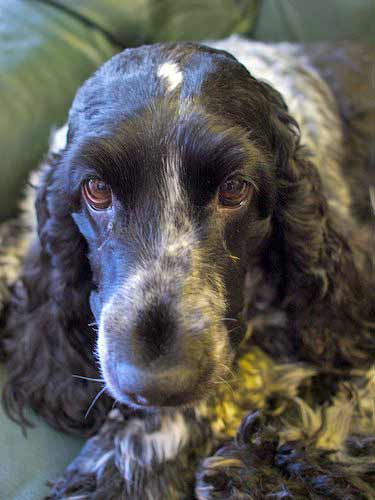 Dog bloat can be very painful for your Cocker Spaniel!
- Large meals, eaten quickly and in one sitting;
- Low quality, dry dog food which is high in grains and fat. Mixed with water, the grains begin fermenting and gas is released into the stomach;
- Feeding your pet either immediately before or immediately after vigorous exercise;
- If your dog has a large deep chest he may be prone to canine bloat;
- It's also thought that stress may be the cause, for example, moving home or introducing another pet into the family;
- It may simply be hereditary;
- It's been suggested that elevated dog food bowls can cause bloat, but I couldn't find any evidence to prove or dispute this theory.
How To Prevent Dog Bloat
There are several things you can do to reduce the chances of your dog suffering from this potentially fatal condition.
- Don't allow your Cocker to become overly stressed or anxious as this can cause your dog to bloat.
- Don't exercise your dog and avoid vigorous play or training either before or immediately after feeding.
- Allowing
your pet to rest after a meal (for at least one hour) will help with digestion and allow any
gases to be released, preferably through the upper body!
- Moving your dog onto a high protein diet and reducing his intake of carbohydrates can help.
- Don't allow him to drink too much water before exercising him or following a meal.
- If your dog is prone to 'wolfing' his food down it could cause dog bloat, so in addition to slowing down his eating (perhaps by hand feeding him) I recommend you split his daily food allowance and feed him twice a day (or even three) rather than one large
meal. He's also less likely to drink as much water after a small
meal.
- Even though I couldn't find any firm evidence for or against, play it safe. Don't use an elevated food bowl!
Dog Bloat: Treatment
Depending on the condition of your dog, your vet will do one of two things.
He may take an x-ray of your Spaniel's abdomen to see if his stomach is twisted or he may feed a rubber tube into his mouth and down into the stomach to release the pressure.
If a tube is inserted and there's a sudden release of gas and/or liquid, it will confirm a straightforward case of dog bloat (gastric dilatation).
The stomach will then be flushed and because your dog won't be allowed to eat for a day or so, he'll be put on an intravenous drip to help sustain him and keep him hydrated.
Where there's no release via the tube, an x-ray will probably show that the stomach has twisted (volvulus) and surgery will be needed . A gastropexy would be performed (where the stomach is pinned into place) and if necessary, any damaged tissue would be removed.
Dog Bloat: Summary
Bloat in dogs can also occur in puppies but it's mostly seen in older adult dogs. It's more commonly seen in the larger chested breeds such as German Shepherds or Great Danes, but it can occur in any dog with a large or deep chest.
It's not a particularly common ailment of Spaniels, but it's not entirely unheard of and if you learn to recognise the symptoms, not only could you save your own dog's life, but you may help to save another pet.
If
you believe your Cocker Spaniel may be
suffering from dog bloat, don't delay because every second counts - get him to your vet's surgery immediately!
Photo credit: Dog Bloat:
1. blogdnd at Flickr.com https://www.flickr.com/photos/37552332@N02/3457771844
2. Nicholas Smale at Flickr.com httpswww.flickr.comphotosnicholassmale4628963620
Recent Articles


-
Want to train your dog to come back to you immediately? Learn how here
Apr 12, 24 12:36 PM
 Teaching your puppy recall is one of the most important things you will ever teach your Cocker. Learn how to train your dog to come back when called.
 -
Want to know how to train a Cocker Spaniel to drop his ball?
Apr 12, 24 12:25 PM
 Train a Cocker Spaniel to let go of whatever's in his mouth, without hesitation, and you won't regret it. This is an excellent command to teach your puppy!
 -
Puppy obedience training can help keep your new puppy safe!
Apr 12, 24 12:13 PM
 Giving your puppy obedience training, such as sit, stay, wait, come etc., will help you to shape a well-behaved puppy and will also help to keep him safe.